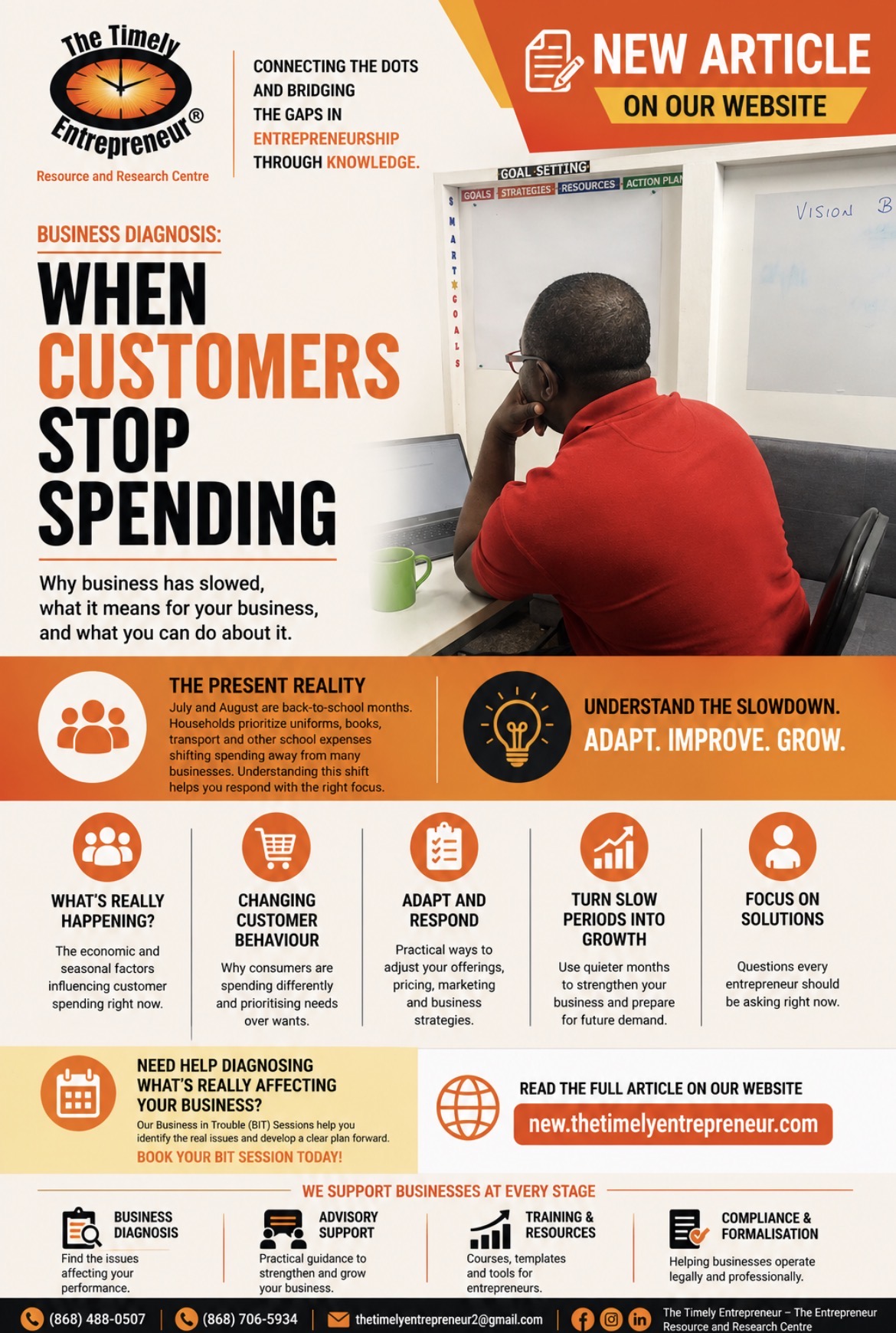
Business Diagnosis: A recurring editorial series from The Timely Entrepreneur Resource and Research Centre examining the issues affecting entrepreneurs and MSMEs in Trinidad and Tobago, together with practical ways businesses can respond.
When Customers Stop Spending: Understanding Today’s Business Slowdown
Helping entrepreneurs understand what’s really happening inside the economy and inside their businesses.
Over the past few weeks, we’ve had conversations with entrepreneurs from different industries, and we’ve been following the business news closely. One comment keeps coming up: – “Business has slowed.” Retailers are saying fewer customers are walking through their doors; service providers are receiving enquiries, but fewer people are committing. Some businesses are seeing customers delay purchases, while others are noticing that clients are buying less than they did just a few months ago. The question is, why?
The current business environment presents several challenges for entrepreneurs.
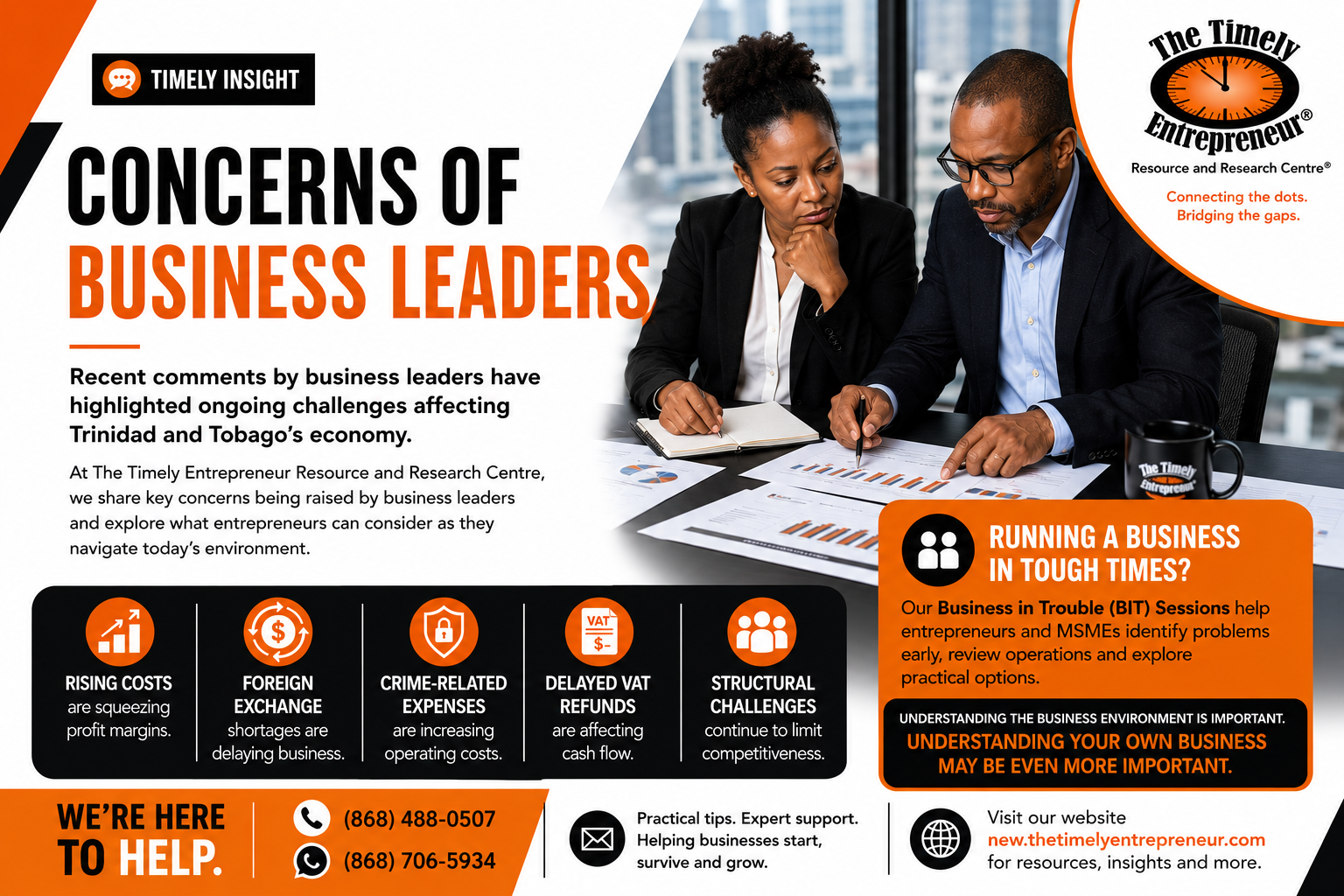
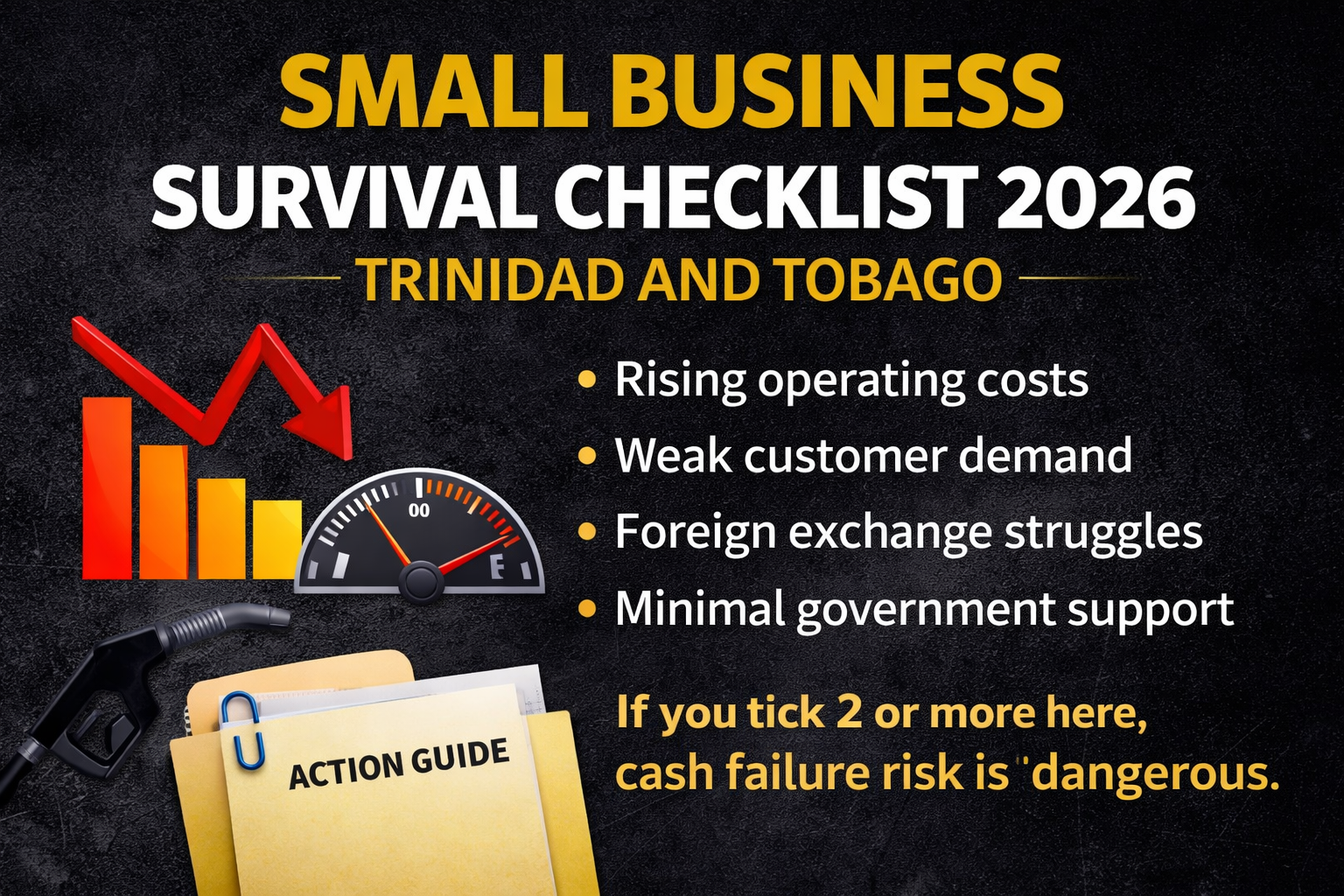
Business organisations have continued to express concerns about higher operating costs, foreign exchange constraints, increased business expenses and softer economic activity. These issues have placed pressure on many businesses across Trinidad and Tobago. At the same time, we are entering one of the most predictable spending periods of the year.
For many households, July and August are no longer ordinary months. They are back-to-school months. Parents are purchasing uniforms, textbooks, school shoes, stationery, transportation, electronic devices and paying registration fees for the new school term beginning in September.
When household budgets are stretched, spending priorities naturally change. This does not necessarily mean consumers have stopped spending; it often means they are spending differently. They have simply changed what they are spending on. Understanding that distinction is important. Economists often describe this as a shift from discretionary spending to essential spending.
For businesses, this can feel like a sudden slowdown. But in reality, customer priorities have simply shifted. Recognising this shift is important because it helps business owners respond strategically rather than emotionally. For many households, these expenses become the priority.
Money that might previously have been spent on dining out, beauty services, entertainment, clothing or discretionary purchases is now redirected (for the next two months at least) towards education.
Consumer Behaviour Has Changed
Instead of asking,“Do I want this?”, they begin asking, “Do I need this right now?”, “Can this wait another month?”, “Is there a less expensive alternative?”, “Will this purchase solve an immediate problem?”
They are signs that customers are thinking differently and businesses that recognise this shift early are usually better positioned to respond.
Business Diagnosis
A temporary slowdown in sales is not necessarily a sign that your business is failing. It may be telling you something else. Perhaps your customers now need more flexible payment options. Perhaps your products or services need to be presented differently. Perhaps this is the right time to strengthen relationships with existing customers rather than focusing only on attracting new ones. Perhaps your pricing, marketing or customer experience needs to be reviewed. Every slowdown provides information. The challenge is learning how to interpret it.
Responding to Changing Consumer Priorities
Economic slowdowns rarely affect every business in exactly the same way. Some businesses continue growing. Others experience significant declines. The difference often lies in how quickly they recognise changing customer behaviour. Businesses should ask themselves an important question:
Has the way my customers buy changed?
If the answer is yes, the business may need to adapt. This does not interpret into lowering prices, as many businesses rush to do when sales aren’t moving. In fact, constant discounting can often make profitability even worse. Instead, entrepreneurs should consider whether their products or services can be presented differently. Could smaller service packages make purchasing easier? Would payment plans encourage customers to proceed? Could products be bundled to increase value? Would subscription or membership options improve recurring income? Can premium services be complemented by more affordable entry-level options?
The objective is not simply to sell more. It is to remain relevant to changing customer needs.
Sometimes the Business Model Needs to Change
One of the greatest dangers during slower periods is assuming that doing more of the same will produce different results. Markets evolve, and so too, do customer expectations, and hence, businesses must evolve too.
A tutor who previously offered only private lessons may introduce small group classes. A restaurant may create family meal packages or corporate lunch specials. A consultant may offer shorter advisory sessions for clients unable to commit to larger projects. A retailer may strengthen online sales and delivery services. A beauty salon may introduce express treatments for customers seeking more affordable options. A contractor may expand into maintenance contracts that generate recurring income rather than depending entirely on new construction projects.
One area of business we see struggling consistently is Consultancy. Consultancies are among the first businesses to feel an economic slowdown because many clients view consulting as something they can postpone. However, the businesses that survive don’t stop selling expertise. They repackage it to match what clients can afford and need at that moment.
Perhaps think in terms of a value ladder, where clients can enter at different price points instead of assuming everyone is ready for a full consulting engagement. Rather than assuming every client is ready for a comprehensive consultancy engagement, consider developing a range of services at different investment levels. A business that cannot commit to a full consulting package today may still invest in a one-hour Business Health Check, a Pricing Review, a Compliance Assessment or a Business Recovery Session. Smaller engagements often build trust, solve immediate problems and naturally lead to larger consulting opportunities when the client’s circumstances improve. These adjustments do not change the identity of the business. They simply reflect a willingness to respond to current market conditions. History consistently shows that businesses prepared to adapt are often the ones that emerge strongest after periods of economic uncertainty.
Slow Periods Can Become Growth Periods
Many entrepreneurs view slower periods as lost time. In reality, they can become some of the most valuable months in the business calendar. When customer demand slows, owners finally have time to work on the business instead of constantly working in it.
This is an ideal opportunity to:
- Review pricing.
- Analyse profitability.
- Identify hidden profit leaks.
- Improve record keeping.
- Strengthen customer relationships.
- Reconnect with past clients.
- Update marketing materials.
- Improve social media presence.
- Review supplier costs.
- Improve inventory management.
- Formalise business processes.
Businesses that invest in improvement during quieter periods often recover faster when demand increases.
Questions Worth Asking
If business has slowed, ask yourself:
- Have my customers’ spending priorities changed?
- Am I communicating the value of my products or services clearly?
- Have I stayed in contact with existing customers?
- Have I reviewed my expenses over the past three months?
- Are there complementary products or services I could introduce?
- Is my cash flow strong enough to manage seasonal fluctuations?
- Am I relying too heavily on one source of income?
- Could my business benefit from introducing something new?
These questions won’t solve every challenge, but they often reveal opportunities that are easy to overlook when you’re busy running the business.
The Timely Takeaway
Economic slowdowns test every business. Some businesses respond by waiting. Others respond by adapting. Entrepreneurs cannot control inflation. They cannot control consumer confidence. They cannot control foreign exchange availability. They cannot control household spending.
They can, however, control how prepared their businesses are to respond. The businesses most likely to succeed are not always the largest. They are often the ones that understand their customers, know their numbers, manage their costs and remain willing to adapt when circumstances change.
Sometimes the greatest opportunity for growth begins during a period that initially feels like decline.
How We Help
At The Timely Entrepreneur Resource and Research Centre, our Business in Trouble (BIT) Sessions help entrepreneurs look beyond the symptoms.
A slowdown in sales is often only one part of the story. Together, we examine pricing, cash flow, expenses, profitability, customer trends, business systems and operational practices to identify what is really affecting performance. Sometimes the issue is the economy; other times it is the business. More often, it is a combination of both.
Helping businesses start, survive and grow.
🌐 new.thetimelyentrepreneur.com
📞 (868) 488-0507 | (868) 706-5934
Timely Business Action Plan
This Week’s Actions
☐ Review your July and August sales against last year.
☐ Contact five existing customers.
☐ Review your three highest-cost expenses.
☐ Identify one service you could repackage.
☐ Schedule one hour to work on your business instead of in it.
☐ Review your pricing.