The Timely Perspective: Should You Borrow Money to Start a Business? Mark Cuban’s Advice Sparks an Important Conversation

Helping entrepreneurs separate popular business advice from practical business decisions.

See Mark’s video here first: If you take out a loan to start a business, you’re a Moron!

Should You Borrow Money to Start a Business? Mark Cuban’s Advice Sparks an Important Conversation

Recently, billionaire entrepreneur Mark Cuban reignited debate among entrepreneurs when he made a blunt statement that quickly spread across social media.

“If you’re starting a business and you take out a loan, you’re a moron.”

Like many memorable business quotes, it attracted attention because of its boldness. But beneath the headline lies a much more important discussion, one that every entrepreneur should have before signing a loan agreement.

At The Timely Entrepreneur Resource and Research Centre, we believe Cuban’s comment deserves careful examination. Not because every entrepreneur should agree with him, but because it forces business owners to ask a critical question:

Should you borrow money before you’ve proven your business can make money?

The answer is not always straightforward.

What Was Mark Cuban Really Saying?

Contrary to what many people assumed, Cuban was not arguing that borrowing money is always a bad idea. His point was that starting a business is already filled with uncertainty. Taking on debt at the very beginning adds one certainty, the loan must still be repaid whether the business succeeds or fails – every month, the bank expects its payment, the credit union expects its payment, the finance company expects its payment, your suppliers expect their payment, your customers, however, are under no obligation to buy. That imbalance is what Cuban was highlighting. A loan does not create customers; it does not guarantee sales; it simply creates another financial obligation that the business must satisfy.

 Many aspiring entrepreneurs begin their journey with one question: “Where can I get funding?” While financing is certainly important, we often believe it has become the first question when perhaps it should be one of the last. Too often, businesses seek loans before answering more fundamental questions:

Is there genuine demand for the product or service? Have customers already shown a willingness to pay? Does the pricing cover all operating costs? How much cash will the business require each month simply to survive? What happens if sales are only half of what was projected? Without answers to these questions, borrowing money can amplify uncertainty rather than reduce it.

Money Does Not Solve Every Business Problem

One of the biggest misconceptions among new entrepreneurs is that a lack of money is the primary reason businesses fail. In reality, many businesses struggle for reasons that additional funding alone cannot fix. These can include:

Poor pricing.

Weak record keeping.

Limited market research.

Poor customer service.

Inadequate marketing.

Cash flow problems.

Failure to understand the numbers.

Giving these businesses more money often delays the problem rather than solves it. Imagine pouring water into a bucket with several holes. Adding more water does not stop the leaks. The leaks must be repaired first. Businesses operate much the same way.

Borrowing Before You’re Ready

One situation we encounter regularly is the entrepreneur who wants to borrow to purchase expensive equipment, rent a large office or invest heavily in inventory before making their first sale. Now there is certainly nothing wrong with ambition. The danger lies in assuming that investment automatically creates demand. Customers do not buy because you’ve purchased expensive equipment. They buy because you solve a problem, they are willing to pay for. Many successful businesses began with modest resources. They reinvested profits gradually rather than borrowing heavily from the outset. That approach reduced financial pressure and allowed the business to grow at a sustainable pace.

But Is Borrowing Always Wrong?

Not at all. This is where context matters. There are many legitimate reasons for businesses to borrow. A manufacturing company may need specialised machinery. A transport business may require commercial vehicles. An established retailer may borrow to expand into a second location. A growing business may need additional working capital to fulfil larger contracts. These are very different situations from borrowing to test whether a business idea might work. The difference is that an established business has evidence: it has customers, it has sales history, it has financial records, it understands its market. In these circumstances, financing often becomes a tool for growth rather than survival.

Borrow to Grow, Not to Guess

Perhaps the most useful lesson entrepreneurs can take from Cuban’s comments is this:

Borrow to grow a proven business, not to guess whether an unproven idea will succeed.

Before approaching a lender, ask yourself:

  • Have I already tested this business idea?
  • Do I understand exactly who my customers are?
  • Have I priced my products or services correctly?
  • Can I realistically meet loan repayments if sales are slower than expected?
  • Have I explored lower-cost ways of starting first?

These questions are often more valuable than the loan itself.

A Better Starting Point

Many businesses today can begin much smaller than entrepreneurs realise. Consultants can start with virtual advisory sessions. Tutors can teach online before renting classrooms. Retailers can validate demand through social media before investing in large quantities of stock. Service providers can begin from home before leasing commercial premises.

Testing an idea on a smaller scale allows entrepreneurs to learn what customers actually want before making significant financial commitments.

The Timely Takeaway

Mark Cuban’s statement may sound harsh, but it highlights an important truth.

Money should support a good business. It cannot create one.

Before borrowing, entrepreneurs should ensure they understand their market, know their numbers and have evidence that customers are willing to buy. Debt is neither good nor bad. It is simply a financial tool, which, if used wisely, can accelerate growth. Used too early, it can magnify risk. The goal should never be to borrow as much as possible, but it should be to build a business strong enough that financing becomes an opportunity rather than a necessity.

How We Help

At The Timely Entrepreneur Resource and Research Centre, many entrepreneurs approach us asking where they can find funding.

Our first response is often another question:

“Is your business truly ready for funding?”

Through our Business in Trouble (BIT) Sessions and business advisory services, we work with entrepreneurs to assess business readiness before they assume additional financial obligations. Together, we review business models, pricing, cash flow, profitability, financial projections and operational readiness, helping business owners make informed decisions rather than expensive mistakes.

Sometimes the best financial decision is not borrowing more. Sometimes it is building a stronger business first.

Helping businesses start, survive and grow.

🌐 new.thetimelyentrepreneur.com

📧 thetimelyentrepreneur2@gmail.com

📞 (868) 488-0507 | (868) 706-5934


Business Diagnosis: A recurring editorial series from The Timely Entrepreneur Resource and Research Centre examining the issues affecting entrepreneurs and MSMEs in Trinidad and Tobago, together with practical ways businesses can respond.

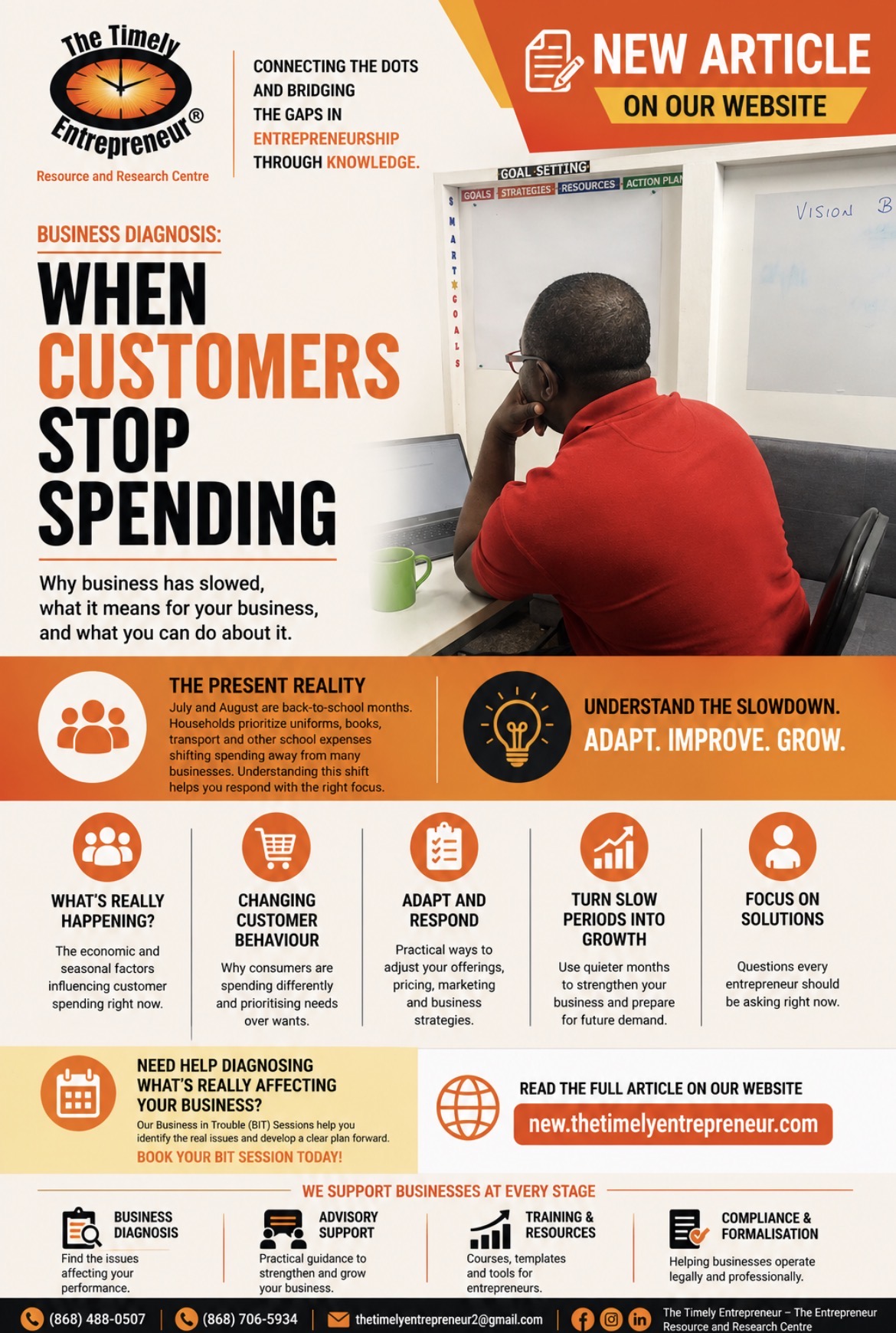
When Customers Stop Spending: Understanding Today’s Business Slowdown

Helping entrepreneurs understand what’s really happening inside the economy and inside their businesses.

Over the past few weeks, we’ve had conversations with entrepreneurs from different industries, and we’ve been following the business news closely. One comment keeps coming up: – “Business has slowed.” Retailers are saying fewer customers are walking through their doors; service providers are receiving enquiries, but fewer people are committing. Some businesses are seeing customers delay purchases, while others are noticing that clients are buying less than they did just a few months ago. The question is, why?

The current business environment presents several challenges for entrepreneurs.

Business organisations have continued to express concerns about higher operating costs, foreign exchange constraints, increased business expenses and softer economic activity. These issues have placed pressure on many businesses across Trinidad and Tobago. At the same time, we are entering one of the most predictable spending periods of the year.

For many households, July and August are no longer ordinary months. They are back-to-school months. Parents are purchasing uniforms, textbooks, school shoes, stationery, transportation, electronic devices and paying registration fees for the new school term beginning in September.

When household budgets are stretched, spending priorities naturally change. This does not necessarily mean consumers have stopped spending; it often means they are spending differently. They have simply changed what they are spending on. Understanding that distinction is important. Economists often describe this as a shift from discretionary spending to essential spending. 

For businesses, this can feel like a sudden slowdown. But in reality, customer priorities have simply shifted. Recognising this shift is important because it helps business owners respond strategically rather than emotionally. For many households, these expenses become the priority.

Money that might previously have been spent on dining out, beauty services, entertainment, clothing or discretionary purchases is now redirected (for the next two months at least) towards education.

Consumer Behaviour Has Changed

Instead of asking,“Do I want this?”, they begin asking, “Do I need this right now?”, “Can this wait another month?”, “Is there a less expensive alternative?”, “Will this purchase solve an immediate problem?”

They are signs that customers are thinking differently and businesses that recognise this shift early are usually better positioned to respond.

Business Diagnosis

A temporary slowdown in sales is not necessarily a sign that your business is failing. It may be telling you something else. Perhaps your customers now need more flexible payment options. Perhaps your products or services need to be presented differently. Perhaps this is the right time to strengthen relationships with existing customers rather than focusing only on attracting new ones. Perhaps your pricing, marketing or customer experience needs to be reviewed. Every slowdown provides information. The challenge is learning how to interpret it.

Responding to Changing Consumer Priorities

Economic slowdowns rarely affect every business in exactly the same way. Some businesses continue growing. Others experience significant declines. The difference often lies in how quickly they recognise changing customer behaviour. Businesses should ask themselves an important question:

Has the way my customers buy changed?

If the answer is yes, the business may need to adapt. This does not interpret into lowering prices, as many businesses rush to do when sales aren’t moving. In fact, constant discounting can often make profitability even worse. Instead, entrepreneurs should consider whether their products or services can be presented differently. Could smaller service packages make purchasing easier? Would payment plans encourage customers to proceed? Could products be bundled to increase value? Would subscription or membership options improve recurring income? Can premium services be complemented by more affordable entry-level options?

The objective is not simply to sell more. It is to remain relevant to changing customer needs.

Sometimes the Business Model Needs to Change

One of the greatest dangers during slower periods is assuming that doing more of the same will produce different results. Markets evolve, and so too, do customer expectations, and hence, businesses must evolve too.

A tutor who previously offered only private lessons may introduce small group classes. A restaurant may create family meal packages or corporate lunch specials. A consultant may offer shorter advisory sessions for clients unable to commit to larger projects. A retailer may strengthen online sales and delivery services. A beauty salon may introduce express treatments for customers seeking more affordable options. A contractor may expand into maintenance contracts that generate recurring income rather than depending entirely on new construction projects.

One area of business we see struggling consistently is Consultancy. Consultancies are among the first businesses to feel an economic slowdown because many clients view consulting as something they can postpone. However, the businesses that survive don’t stop selling expertise. They repackage it to match what clients can afford and need at that moment.

Perhaps think in terms of a value ladder, where clients can enter at different price points instead of assuming everyone is ready for a full consulting engagement. Rather than assuming every client is ready for a comprehensive consultancy engagement, consider developing a range of services at different investment levels. A business that cannot commit to a full consulting package today may still invest in a one-hour Business Health Check, a Pricing Review, a Compliance Assessment or a Business Recovery Session. Smaller engagements often build trust, solve immediate problems and naturally lead to larger consulting opportunities when the client’s circumstances improve. These adjustments do not change the identity of the business. They simply reflect a willingness to respond to current market conditions. History consistently shows that businesses prepared to adapt are often the ones that emerge strongest after periods of economic uncertainty.

Slow Periods Can Become Growth Periods

Many entrepreneurs view slower periods as lost time. In reality, they can become some of the most valuable months in the business calendar. When customer demand slows, owners finally have time to work on the business instead of constantly working in it.

This is an ideal opportunity to:

  • Review pricing.
  • Analyse profitability.
  • Identify hidden profit leaks.
  • Improve record keeping.
  • Strengthen customer relationships.
  • Reconnect with past clients.
  • Update marketing materials.
  • Improve social media presence.
  • Review supplier costs.
  • Improve inventory management.
  • Formalise business processes.

Businesses that invest in improvement during quieter periods often recover faster when demand increases.

Questions Worth Asking

If business has slowed, ask yourself:

  • Have my customers’ spending priorities changed?
  • Am I communicating the value of my products or services clearly?
  • Have I stayed in contact with existing customers?
  • Have I reviewed my expenses over the past three months?
  • Are there complementary products or services I could introduce?
  • Is my cash flow strong enough to manage seasonal fluctuations?
  • Am I relying too heavily on one source of income?
  • Could my business benefit from introducing something new?

These questions won’t solve every challenge, but they often reveal opportunities that are easy to overlook when you’re busy running the business.

The Timely Takeaway

Economic slowdowns test every business. Some businesses respond by waiting. Others respond by adapting. Entrepreneurs cannot control inflation. They cannot control consumer confidence. They cannot control foreign exchange availability. They cannot control household spending.

They can, however, control how prepared their businesses are to respond. The businesses most likely to succeed are not always the largest. They are often the ones that understand their customers, know their numbers, manage their costs and remain willing to adapt when circumstances change.

Sometimes the greatest opportunity for growth begins during a period that initially feels like decline.

How We Help

At The Timely Entrepreneur Resource and Research Centre, our Business in Trouble (BIT) Sessions help entrepreneurs look beyond the symptoms.

A slowdown in sales is often only one part of the story. Together, we examine pricing, cash flow, expenses, profitability, customer trends, business systems and operational practices to identify what is really affecting performance. Sometimes the issue is the economy; other times it is the business. More often, it is a combination of both.

Helping businesses start, survive and grow.

🌐 new.thetimelyentrepreneur.com

📞 (868) 488-0507 | (868) 706-5934

Timely Business Action Plan

This Week’s Actions

☐ Review your July and August sales against last year.

☐ Contact five existing customers.

☐ Review your three highest-cost expenses.

☐ Identify one service you could repackage.

☐ Schedule one hour to work on your business instead of in it.

☐ Review your pricing.

To protect client confidentiality, identifying details have been changed. The situations described are based on real business challenges encountered through our work with entrepreneurs.

Real business situations. Practical lessons for entrepreneurs.

Recently, during one of our Business in Trouble (BIT) Sessions, we reviewed a service-based business that, from the outside, appeared to be doing well: appointments were fully booked most weeks, customers kept returning, the business had built a loyal client base, and anyone looking at the appointment book would probably conclude that business was thriving.

Yet, during our discussion, the owner made a remark that suddenly had them thinking…

“If business is so busy, how come we don’t see this reflected in dollars and cents at the end of the month?”

Digging further, here’s what we found: it wasn’t a lack of customers, it wasn’t poor service and it wasn’t about the marketing. We discovered the hidden profit leaks.

Like many entrepreneurs, the owner had become so focused on serving customers that several small issues had quietly developed over time. Individually, they didn’t seem important. Together, they were steadily reducing the business’s profitability.

Hidden Profit Leak No. 1

Prices Hadn’t Kept Pace with Rising Costs

The salon’s prices had remained largely unchanged for several years. Meanwhile, the cost of products, utilities, rent and everyday operating expenses had continued to increase. Every appointment still generated income, but each one was contributing less profit than before.

Many business owners believe staying competitive means keeping prices low. Unfortunately, failing to review pricing regularly often means the business quietly absorbs rising costs instead.

Hidden Profit Leak No. 2

Time Was Being Given Away

Appointments were scheduled for one hour. But many lasted much longer. Clients frequently requested an additional service or “just one more thing.” Because the owner genuinely cared about customer satisfaction, she rarely charged for the additional time. Over weeks and months, those extra fifteen or twenty billable minutes became several hours of unpaid work.

For a service-based business, time is inventory. Once it has been given away, it can never be sold again.

Hidden Profit Leak No. 3

Small Purchases Were Becoming Big Expenses

Whenever supplies ran low, another trip to the beauty supplier seemed necessary. Whether it be a bottle of shampoo, disposable gloves, styling products, coffee, or even a small chicken roti while out. Each purchase seemed insignificant. But they represented hundreds of dollars every month that had never been budgeted.

Hidden profit leaks often begin with spending that nobody thinks is worth tracking.

Hidden Profit Leak No. 4

Missed Appointments Were Going Unpaid

Some clients cancelled at the last minute; others simply didn’t show up. Because there was no cancellation policy, those appointment times remained empty. Unlike a retailer that can sell the same product tomorrow, a salon loses that income forever once the appointment time has passed. One missed appointment may not seem serious. Several missed appointments every month can significantly affect profitability.

Hidden Profit Leak No. 5

Personal and Business Money Were Mixed Together

Throughout the week, business income was regularly used to purchase groceries, gas and other household expenses. By the end of the month, it became difficult to determine how much profit the business had actually earned. Without reliable financial information, business decisions become based on assumptions rather than facts.

Understanding where your money is going is just as important as understanding where it is coming from.

What We Found

This business simply needed to stop the money that was quietly leaking out of the business.

After reviewing pricing, introducing a cancellation policy, improving inventory management and separating business and personal finances, the salon became more profitable without attracting a single new client.

The number of customers remained almost exactly the same. The difference was that more of the money being earned stayed in the business.

Questions Worth Asking

Before assuming your business needs more customers, take a moment to ask yourself:

  • Are my prices still appropriate for today’s costs?
  • Am I giving away products, services or time without charging for them?
  • Do I know exactly where my money is going every month?
  • Could small, everyday habits be quietly reducing my profits?

Sometimes the quickest way to improve profitability isn’t by increasing sales. Sometimes it’s by identifying the money that’s already slipping through the cracks.

If those questions made you stop and think, your business may benefit from a closer review.

The Timely Takeaway

A busy business is not always a profitable business. Before investing more money in advertising or trying to attract more customers, first determine whether hidden profit leaks are reducing the income you’re already earning.

How We Help

Through our Business in Trouble (BIT) Sessions, The Timely Entrepreneur Resource and Research Centre works alongside entrepreneurs and MSMEs to examine what is really happening inside their businesses. We don’t simply look at sales. We examine pricing, cash flow, expenses, profitability, business systems, compliance and the day-to-day decisions that influence long-term performance.

Sometimes a fresh set of experienced eyes can identify opportunities and problems that are easy to miss when you are busy running the business. Every business has a story. Sometimes the numbers tell a different one. If your business feels busy but the results aren’t matching the effort, it may be time to look beneath the surface.

Helping businesses start, survive and grow.

🌐 new.thetimelyentrepreneur.com 📞 (868) 488-0507 | (868) 706-5934


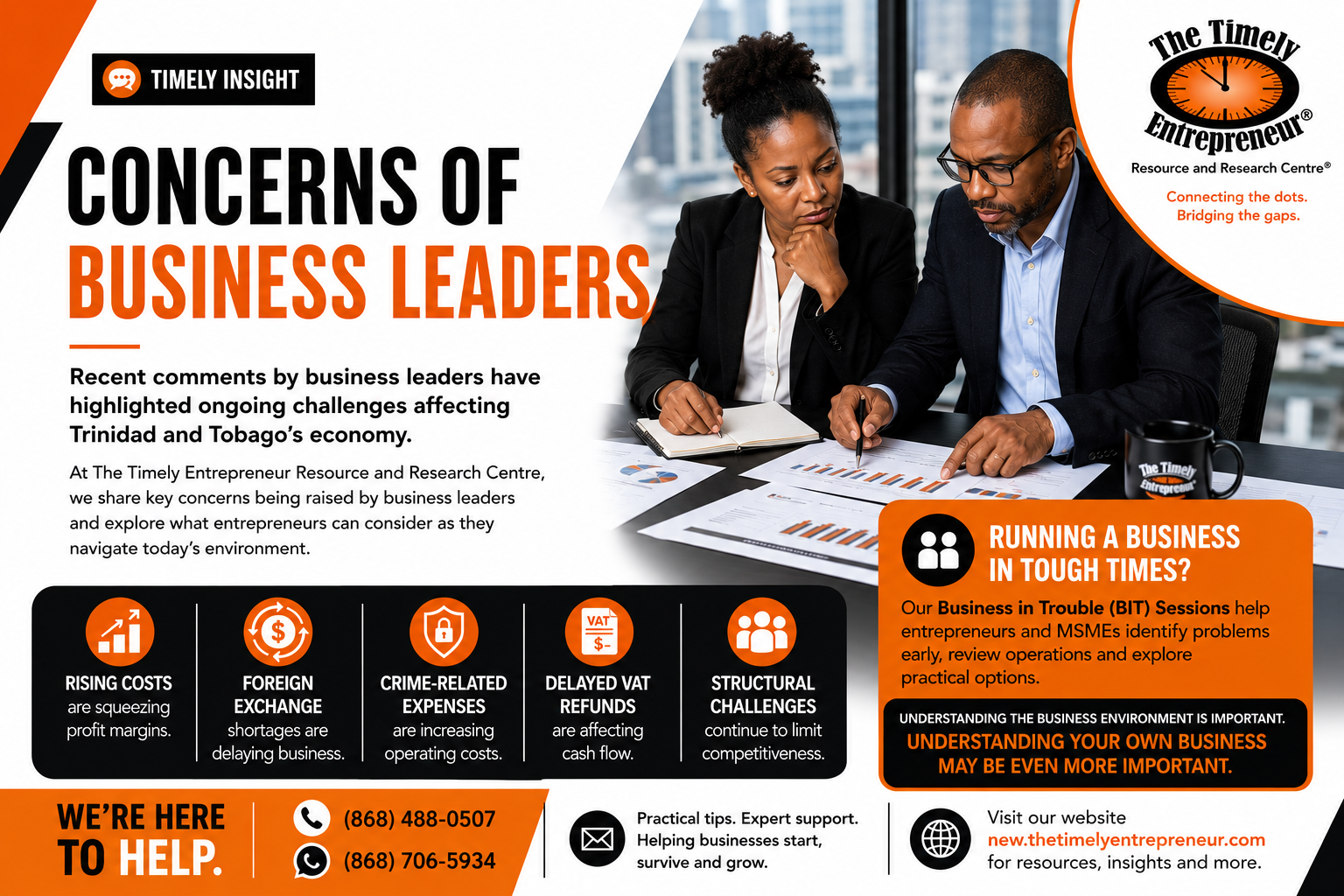
Recent comments by businessman Robin Ojeer and Sieunarine Kumar Hardath, director of Hardath General Insurance Consultants Ltd, have reignited discussion about the state of Trinidad and Tobago’s economy. Both businessmen point to issues that many entrepreneurs and business owners have been quietly confronting for years: rising operating costs, foreign exchange constraints, delayed VAT refunds, crime-related expenses and what they perceive as a lack of meaningful progress on deeper structural challenges affecting the economy.

Read the full article via Guardian Media here: https://www.guardian.co.tt/business/tts-economy-is-dying-businesses-lash-govt-policies-6.2.2608899.34357468a3#google_vignette

At The Timely Entrepreneur Resource and Research Centre, we believe these concerns deserve careful consideration, not because they represent isolated opinions, but because they reflect realities being experienced across the business landscape. Whether one agrees with every criticism or not, the observations made by Ojeer and Hardath raise important questions about confidence, competitiveness and the operating environment facing micro, small and medium-sized enterprises. More importantly, they remind us that understanding the broader economy is essential for entrepreneurs seeking to make sound decisions in increasingly uncertain times.

These rising operating costs, crime-related expenses, limited access to foreign exchange and increasing uncertainty are creating conditions that are becoming difficult for many firms to navigate. Recent reactions to the Mid-Year Budget Review have highlighted concerns that the challenges facing businesses are not being adequately addressed.

For many entrepreneurs, these concerns are not theoretical. They are being experienced every day.

Security costs continue to rise. Businesses are spending more on cameras, alarms, gates, insurance and private security, adding another layer of expense to already strained operations. Small businesses, which often operate on tight margins, are finding it increasingly difficult to absorb these additional costs.

The foreign exchange shortage remains another major source of concern. Importers and manufacturers are experiencing delays and uncertainty when trying to access US currency to purchase goods and raw materials. Businesses that depend on imported products are often forced to source foreign currency elsewhere at higher costs, which eventually affects pricing and profitability.

Economic uncertainty itself creates another problem. When consumers become cautious about spending, businesses experience slower sales and reduced cash flow. Expansion plans are delayed, investments are postponed and confidence weakens.

While many business owners are looking to government policies for relief, entrepreneurs must also recognise that survival cannot depend entirely on external solutions. Businesses that are waiting for perfect economic conditions may find themselves waiting indefinitely.

This period calls for stronger internal management and greater adaptability.

Business owners should pay close attention to cash flow and reduce unnecessary expenses. Inventory management, debt collection and pricing decisions require constant review. Businesses that understand their numbers are generally better positioned to respond to changing conditions.

Diversification is becoming increasingly important. Companies that rely heavily on a single customer, product or revenue stream face greater vulnerability. Exploring new markets, introducing complementary services and embracing digital opportunities can help reduce risk.

Local sourcing should also be considered where possible. Although not every imported item can be replaced, businesses that develop relationships with local suppliers may reduce some of their exposure to foreign exchange challenges.

Another area requiring attention is business formalisation and compliance. In difficult economic times, access to financing, partnerships and growth opportunities often favours businesses that maintain proper records and operate within regulatory requirements. Informal businesses may find themselves excluded from opportunities precisely when they need them most.

This reality is particularly relevant in our business eco-system, where many micro and small enterprises operate successfully for years without formal registration, proper records or full compliance. Home-based caterers, online retailers, hairdressers, barbers, tutors, contractors, event planners and service providers often generate steady income and maintain loyal customers, yet remain vulnerable when circumstances change. During difficult economic periods, these businesses may discover that the absence of proper systems and documentation limits their ability to access loans, secure insurance, participate in government procurement, attract investors or form partnerships with larger organisations.

Ironically, the very moment when a business needs support, whether because of rising costs, declining sales or the need to expand into new markets, is often when informality becomes a disadvantage. A contractor with years of experience but no documented financial records may struggle to obtain financing. A home-based food business may be unable to supply larger institutions. An online retailer with strong sales may find itself excluded from opportunities requiring proof of income, business registration or compliance. In an increasingly demanding environment, formalisation is no longer simply about satisfying regulatory requirements. It is about positioning businesses to access opportunities, withstand shocks and remain competitive.

Perhaps the greatest danger facing businesses today is not simply the economic environment, but the temptation to become paralysed by uncertainty, as we have been seeing here at The Timely Entrepreneur. Difficult periods demand careful decisions, but they also require action.

Trinidad and Tobago has faced economic challenges before. Businesses have survived recessions, pandemics, foreign exchange shortages and changing markets. Those that endured were not necessarily the largest or the strongest. They were often the ones willing to adjust, rethink and remain disciplined.

The concerns being raised by businesses deserve serious attention. Because while entrepreneurs cannot determine national economic policy, they can determine how prepared their businesses are to navigate an increasingly demanding environment. However, entrepreneurs cannot afford to surrender their future to circumstances beyond their control. Economic conditions may be challenging, but good management, sound decision-making and adaptability remain powerful tools for survival.

At The Timely Entrepreneur Resource and Research Centre, we continue to believe that knowledge, preparation and practical support remain essential for businesses seeking not only to survive difficult times, but to position themselves for long-term growth.

While uncertainty may be unavoidable, helplessness is not!

Is Your Business Feeling the Pressure?

If rising costs, declining sales, cash flow challenges or uncertainty about the next step are beginning to affect your business, it may be time for an objective review.

Through our Business in Trouble (BIT) Sessions, The Timely Entrepreneur Resource and Research Centre works with entrepreneurs and MSMEs to identify problems early, review operations and explore practical options before small issues become major crises.

Understanding the business environment is important. Understanding your own business may be even more important.


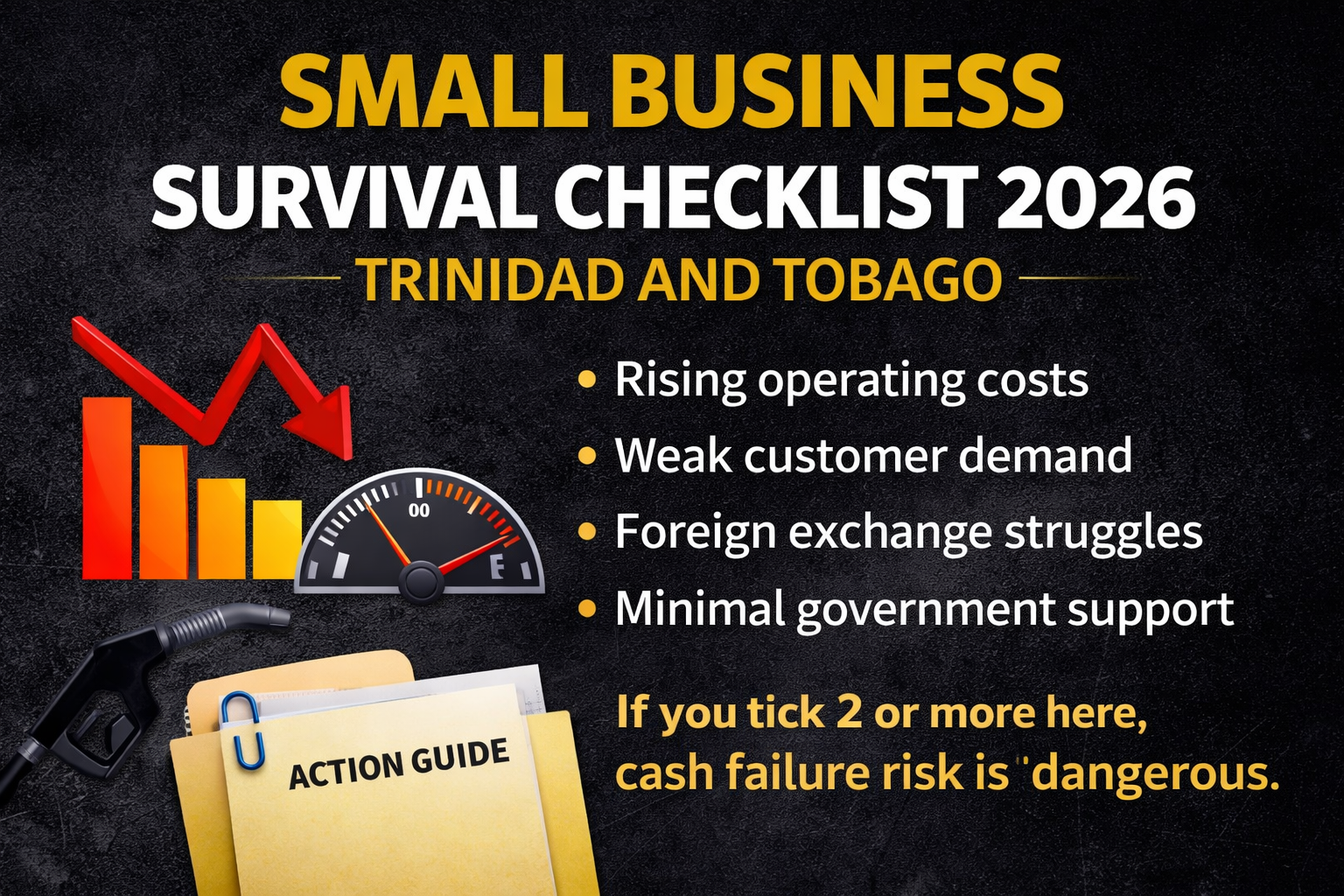
The 2026 economic reality

The team at The Timely Entrepreneur Resource and Research Centre met recently to discuss the Economic Outlook for 2026. Here is a direct, unsentimental assessment for 2026, written for people who actually have to survive in the Trinidad and Tobago economy.

Stripped of comfort language

The outlook for 2026 is fragile and deteriorating beneath the surface. The headline numbers still lean on energy, but the underlying economy is showing classic late-cycle stress. Growth is narrow, costs are sticky, foreign exchange remains structurally constrained, and the State’s room to cushion shocks is shrinking.

Energy revenues may hold up on paper, but gas supply constraints, maintenance downtime, and global price volatility mean cash flows will be uneven. Non-energy growth is weak because domestic demand is under pressure and operating costs are rising faster than incomes. See more below:-

Why non-energy growth in Trinidad and Tobago is weak

1. Real household income is falling

Wages in the non-energy economy have not kept pace with cumulative increases in food, utilities, rent, transport, insurance, and education costs. When real income declines, discretionary spending contracts. Non-energy sectors depend heavily on domestic consumption, so lower purchasing power translates directly into weaker sales volumes.

2. Domestic demand is narrow and concentrated

Consumption is concentrated in essentials. Spending on non-essential goods and services is being postponed or reduced. This limits growth in retail, hospitality, personal services, creative industries, and discretionary manufacturing.

3. High operating costs compress margins

Non-energy businesses face rising electricity charges, logistics costs, rent, security, insurance, and compliance expenses. These costs increase faster than revenues, forcing firms to scale back operations, delay expansion, or exit markets.

4. Foreign exchange constraints restrict supply

Non-energy sectors are import-dependent for inputs, equipment, raw materials, and inventory. FX shortages delay restocking, raise supplier prices, and reduce production capacity. Firms cannot scale output without reliable access to foreign exchange.

5. Limited access to affordable credit

Tighter bank lending standards, higher interest rates, and stricter documentation requirements reduce financing for expansion, working capital, and technology upgrades in non-energy sectors.

6. Weak productivity growth

Capital investment outside energy is limited. Many firms operate with outdated equipment, inefficient processes, and limited automation. Productivity gains are insufficient to offset rising costs, keeping unit costs high.

7. Public sector consolidation dampens spillovers

Fiscal restraint limits public-sector driven demand and procurement spillovers that historically supported non-energy activity. Delays in State payments further constrain cash flow for contractors and suppliers.

8. Small market size limits scale

Trinidad and Tobago’s domestic market is limited. Without consistent export expansion, non-energy firms face saturation quickly, capping growth potential.

9. Business confidence is fragile

Uncertainty around taxes, compliance enforcement, energy prices, and economic policy timing reduces private investment. Firms postpone hiring, capital spending, and market expansion.

10. Structural dependence on energy revenues

Non-energy activity remains indirectly tied to energy through public spending, FX availability, and liquidity. When energy performance softens or becomes volatile, non-energy sectors slow even if their fundamentals are unchanged.

These factors operate simultaneously. The result is low volume growth, thin margins, and limited expansion capacity across the non-energy economy.

Inflation is no longer the sudden spike of previous years. It is now embedded. Food, utilities, insurance, logistics, rent, compliance costs, and financing charges are resetting at higher levels and staying there. That is more dangerous for small businesses than short bursts of inflation, because it erodes margins quietly and continuously.

The foreign exchange situation remains a structural problem. It is not a temporary shortage. Import-dependent businesses will face delays, higher supplier demands for prepayment, and periodic inability to restock. This will worsen as global credit tightens and correspondent banking becomes more conservative.

Government Policy Impacts

Government policy in 2026 signals restraint, not rescue. Here is what this really means in concrete, observable terms.

1. No broad stimulus spending

The 2026 fiscal stance is not expansionary. There is no large-scale injection of new spending designed to boost demand across the economy. Capital expenditure is selective and controlled, not wide-ranging. This means the State is not stepping in to lift consumption or offset private-sector weakness.

2. Tight control over recurrent expenditure

Government is focused on containing wage growth, transfers, and subsidies. Any increases are targeted and limited. This signals that protecting fiscal balances is a higher priority than cushioning households or businesses broadly.

3. Rationalisation of subsidies and concessions

Energy, utility, and social subsidies are being reviewed and narrowed. The direction is toward reducing fiscal leakage, not expanding relief. Businesses should expect less price buffering from the State and more exposure to real market costs.

4. Emphasis on compliance and revenue collection

Policy focus has shifted from accommodation to enforcement. Tax compliance, NIS contributions, fees, and penalties are being tightened. This raises revenue without stimulating activity and increases operating pressure on firms that are marginal or informal.

5. Cost-shifting rather than cost-absorption

Instead of absorbing rising costs, government policy increasingly passes them through to users and businesses. Examples include higher fees, utility adjustments, and reduced concessions. This is a restraint signal because it prioritises fiscal sustainability over short-term relief.

6. Limited intervention in distressed sectors

There is no clear framework for widespread bailouts, debt relief, or emergency support for struggling industries or MSMEs. Assistance is conditional, case-by-case, or indirect. Firms cannot assume the State will step in if conditions worsen.

7. Conservative fiscal assumptions

Budget projections rely on cautious spending paths rather than optimistic growth-driven revenue expansion. This reflects risk aversion and a desire to preserve buffers, not deploy them aggressively.

8. Protection of fiscal buffers over economic stimulus

Foreign reserves, the Heritage and Stabilisation Fund, and debt metrics are being preserved. The State is signalling that these buffers are for systemic crises, not for sustaining weak growth or propping up businesses.

What this means in plain terms

The Government’s posture in 2026 is one of containment and discipline, not economic rescue. It is managing downside risk to public finances rather than attempting to reignite growth through spending or relief.

For businesses and households, this means:

  • Do not expect sweeping relief measures.
  • Do not rely on subsidies to stabilise costs.
  • Do not assume government intervention if cash flow tightens.

The burden of adjustment is being shifted to the private sector and households. 

Subsidies are being rationalised, compliance is tightening, and social spending is being re-targeted. Small businesses should assume less tolerance for arrears, less flexibility from State agencies, and more scrutiny, not more support. Click the link to read more on this here: Build Wealth, Don’t Depend on NIS

Hard truths small businesses must accept now

First, revenue instability is the new normal. If your business requires steady monthly sales just to survive, it is already at risk.

Second, cost increases will not reverse. Electricity, rent, shipping, and insurance costs in Trinidad and Tobago are structurally higher, not temporarily elevated. They are driven by fuel pricing, utility cost recovery, insurance risk re-pricing, global logistics costs, crime exposure, and tighter regulatory requirements. None of these drivers are reversing in the near term.

Businesses that delay price adjustments, cost restructuring, or operating changes in the hope that these expenses will fall are basing decisions on expectation rather than evidence. Since revenues are not rising at the same pace, waiting erodes margins, drains cash, and weakens the business each month.

In practical terms, hoping costs will fall postpones necessary action and increases the risk of failure.

Third, access to finance will tighten further. Banks will lend, but only to businesses that can show discipline, documentation, and predictable cash flows. Informality will be punished quietly simply through denial. In 2026, informal businesses are unlikely to be shut down publicly or aggressively. Instead, they will be excluded. They will be denied access to bank financing, government contracts, corporate clients, digital payment platforms, insurance coverage, and formal partnerships because they cannot meet documentation, compliance, or reporting requirements. No warning is required for this to happen.

The punishment is quiet because the business is not confronted or prosecuted. It simply finds that doors stop opening, opportunities disappear, and growth becomes impossible.

Fourth, customer behaviour has changed permanently. Households are trading down, delaying purchases, sharing services, and questioning value more aggressively. Loyalty is thinner. Price sensitivity is higher. Households and businesses have less discretionary income and tighter cash flow. Customers compare prices more closely, trade down to cheaper alternatives, reduce quantities, or stop buying altogether when prices rise. This means small price increases now trigger stronger reactions than in the past, directly affecting sales volume and customer retention.

Fifth, compliance is no longer optional camouflage. Businesses that “fly under the radar” will struggle to scale, access credit, or partner with corporates and institutions.

What small businesses must do immediately to survive 2026

1. Ruthless financial control

You must know, weekly, not monthly:

  • Which products or services actually generate cash.
  • Which ones only generate activity.
  • Your true break-even point with current costs, not last year’s.

Cut offerings that drain cash, even if they are popular or emotionally attached. Popular does not pay bills.

Move from annual thinking to rolling 90-day cash forecasting. If you cannot see three months ahead, you are already late.

2. Rebuild pricing around reality, not fear

Many small businesses are underpricing out of fear of losing customers. In 2026, underpricing is more dangerous than losing low-value customers.

You must:

  • Separate price-sensitive customers from value-driven ones.
  • Create tiered offerings, not one price for everyone.
  • Be explicit about what costs more and why.

If customers cannot accept price increases, then reduce scope, not margins.

3. Reduce dependency risks

If your business relies on:

  • One supplier.
  • One major customer.
  • One income stream.
  • One location.
  • One platform.

You are exposed.

Diversify suppliers locally where possible, even at slightly higher unit cost. Reliability beats cheap in unstable conditions.

Build at least one secondary income line that is not dependent on imports or long credit chains.

4. Formalise selectively but properly

You do not need excessive bureaucracy, but you do need:

  • Clean records.
  • Up-to-date filings.
  • Basic management accounts.

This is not about pleasing the State. It is about surviving when cash tightens and only disciplined businesses can negotiate, borrow, or pivot.

5. Shift from growth obsession to resilience

2026 is not about rapid expansion. It is about endurance.

That means:

  • Smaller, stronger operations.
  • Fewer fixed costs.
  • More variable cost models.
  • Leasing instead of buying where possible.
  • Partnerships instead of solo scaling.

Practical income generation and diversification paths that make sense now

Not all diversification is smart. Many small businesses fail because they chase everything. The following directions reflect actual economic pressure points:

1. Service over product where possible

Services:

  • Require less foreign exchange.
  • Adjust prices faster.
  • Carry lower inventory risk.

Knowledge-based services, maintenance, training, compliance support, repair, and local logistics will outperform imported retail over the next two years.

2. Recurring income models

One-off sales are unstable in a tightening economy.

Think in terms of:

  • Retainers.
  • Subscriptions.
  • Maintenance contracts.
  • Memberships.
  • Bundled service periods.

Predictability is power in uncertain conditions.

3. B2B over B2C where feasible

Households are under pressure. Businesses still need services to operate.

Target:

  • SMEs that must remain compliant.
  • Corporates outsourcing non-core functions.
  • Schools, NGOs, and institutions with budgeted spending cycles.

Margins may be tighter, but payments are more predictable.

4. Local substitution niches

Import friction creates opportunity.

Look for:

  • Products or services businesses importing simply because “that’s how it’s always been.” Many businesses continue importing certain products or services out of habit rather than necessity. The original reasons may have been quality, availability, or cost advantages that no longer exist. In the current environment, import dependence driven by routine rather than analysis increases exposure to foreign exchange shortages, shipping delays, and higher costs, even when local or regional alternatives could meet the need adequately.
  • Small-batch local alternatives – this refers to locally produced goods or services made in limited quantities that substitute for imported products. They reduce foreign exchange exposure, shorten supply chains, and allow faster price and product adjustments. They may not match large-scale imports on volume or unit cost, but they offer reliability, flexibility, and resilience in a constrained economic environment.
  • Hybrid models where part of the value is local. Hybrid models are business arrangements where some components are imported, but a significant portion of the value creation happens locally. This can include local assembly, customization, servicing, packaging, or distribution. These models reduce foreign exchange exposure, lower logistics risk, and allow businesses to maintain functionality and quality while adapting to supply constraints and cost pressures.

You do not need to replace imports entirely. You only need to reduce dependency.

5. Regional and digital income streams

TT is a small market with limited growth.

Digital services, remote consulting, content-based products, online training, and regional service delivery reduce dependence on local demand alone. Foreign currency income is a buffer, not a luxury.

The uncomfortable conclusion

2026 will not reward hope, optimism, or hustle alone. It will reward discipline, realism, and adaptability.

Small businesses that survive will not be the loudest or most visible. They will be the ones that:

  • Control cash tightly.
  • Price honestly.
  • Cut early rather than late.
  • Diversify carefully, not emotionally.
  • Accept that the environment has changed and act accordingly.

This is not an economic collapse where all businesses fail at once. Economic activity continues, but under tighter conditions. It is a sorting phase where businesses with weak finances, poor pricing, high dependency, or low discipline are pushed out, while those that are well-managed, adaptable, and resilient remain and gain market share.

Businesses that adjust now will still be standing when conditions improve. Those that wait for things to “go back to normal” will quietly exit.

The Timely Entrepreneur’s Guide: How to Negotiate Like a Pro 

A playbook for closing deals, retaining clients, and maximizing value—Caribbean edition.


Table of Contents 

The Psychology of Negotiation 

Pre-Negotiation Prep 

6 Proven Caribbean-Tested Tactics 

Handling Objections 

Closing with Confidence 

Practice Scenarios 


The Psychology of Negotiation 

Key Mindsets: 

Win-Win or Walk Away: Never force a deal that erodes trust. 

Anchor First: The first number on the table sets the tone. 

Silence is Power: Pauses pressure the other party to fill the gap. 

Caribbean Context: 

Relationship-first: “Lime and talk” builds rapport before numbers. 

Flexibility: Be ready for “Island time” delays in decisions. 


Pre-Negotiation Prep 

Checklist: 

Know Your BATNA (Best Alternative to a Negotiated Agreement): What’s our Plan B if this fails?

Research Their Pain Points: Are they pressured by quarterly targets? Competitor threats?

Define Walk-Away Terms: Minimum acceptable price/terms.


6 Proven Caribbean-Tested Tactics 

Tactic 1: The “Trini Aunty” Approach 

Start with warmth, then get strategic.

Script: 

We’re excited to help—let’s find a way that works for both sides. What’s your ideal outcome?

Tactic 2: Trade, Don’t Discount 

Swap concessions instead of lowering prices.

Example: 

“If you commit to a 12-month contract, we’ll include a free resilience audit.” 

Tactic 3: The “Colmado” Principle

Bundle small wins.

Script:

“For [X] price, you’ll get [Y] AND [Z]—like buying a ‘pack’ at the corner shop!”

Tactic 4: Leverage Local Pride 

Appeal to community impact.

Script: 

 “Partnering with us means supporting Caribbean-owned research and innovation.” 

Tactic 5: The “Carnival Deadline” 

Create urgency without pressure.

Script: 

“”This offer stands until Friday—just like Carnival, it’s a limited-time experience!” 

Tactic 6: The “Steelpan Pause” 

“Let silence work for you.” 

After presenting terms, wait 5+ seconds. 


Handling Objections 

Objection | Response  

| “It’s too expensive.” | “What budget were you hoping for? Let’s tailor a package.” | 

| “We need to think.” | “Of course! What specific concerns should I address now?” | 

| “Your competitor offers X.” | “Interesting! How do they handle [unique value you provide]?” | 


Pro Tip: Reframe with “I understand… however…” (e.g., “I understand cost is key—however, our ROI is 3X industry average.”). 


Closing with Confidence 

 Signals They’re Ready: 

– Asking about implementation. 

– Nodding/saying “That makes sense.” 


 Scripts: 

– Assumptive Close: “Should we start onboarding on Monday or Wednesday?” 

– Sharp Angle Close: “If I include [bonus], can we sign today?” 


Never: “So… do you want it?” 

Practice Scenarios

Role-Play 1: The Hesitant Client 

– You: Pitch a 6-month BCP consulting package ($5K). 

– Client: “We only have $3K.” 

– Goal: Trade concessions (e.g., reduce scope but lock in a contract). 


Role-Play 2: The Comparison Shopper 

– Client: “Company X charges less.” 

– You: Highlight unique differentiators (e.g., “Our products are Trinidad-tested—here’s a case study.”). 


“In the Caribbean, we don’t just negotiate deals—we build partnerships. Go get ‘em!” 

— The Timely Entrepreneur Sales Team

RECESSION MARKETING PLAYBOOK


By The Timely Entrepreneur Resource and Research Centre 


The Reality of Recessions 

Let’s face it—economic downturns are brutal. Customers tighten their wallets, competitors get desperate, and many businesses vanish. But here’s the truth: recessions also create HUGE opportunities for brands that adapt quickly. It’s what those in business identify as the perfect storm’.

The Timely Entrepreneur Resource and Research Centre will show you how to not just survive—but THRIVE—with our proven Recession Marketing Playbook. 

By the end of this session, you’ll have 3 actionable strategies to recession-proof your marketing, retain customers, and even gain market share. Let’s dive in!” 

Part 1: Recession Consumer Psychology 

  1. “Fear + Frugality Win”

   – During recessions, people don’t stop spending—they spend DIFFERENTLY. They prioritize value, trust, and essentials. Your job? Speak directly to those needs.


  1. The 3 R’s of Recession Buyers:

   – Reassurance: “Will this solve my problem LONG-TERM?” 

   – Reduction: “Can I get it cheaper or slower?” 

   – Rewards: “What extra value can you throw in?” 

Case Study: “When Airbnb rebranded during the 2008 crash, they didn’t sell ‘vacations’—they sold ‘earning extra cash from your spare room.’ Revenue jumped 80%.” 


Part 2: 3 Recession-Proof Marketing Strategies 

 Strategy 1: Double Down on Existing Customers 

Acquiring new customers costs 10X more than retaining old ones. Here’s how to keep them loyal:

– “We know times are tough. That’s why we’re giving YOU, our valued customers, [exclusive discount/free upgrade/early access]—because you matter more than ever.” 

Tool: Check out our Loyalty Email Subject Lines Templates

Strategy 2: Reframe Your Value (Not Your Price) 

Discounting is a race to the bottom. Instead, bundle or reposition:

– Example: Don’t sell ‘cleaning services’—sell ‘Time-Saving Sanity Packages for Stressed Parents.’ Charge MORE for convenience.

Exercise: Write down your core service. Now add ‘so you can…’ to highlight outcomes. 


 Strategy 3: Hyper-Targeted, Low-Cost Channels 

Forget spray-and-pray. Focus on high-ROI platforms: 

– Email: 42% ROI (vs. 2% for social ads). Resend unopened emails with ‘Did you forget?’ subject lines. 

– WhatsApp/SMS: 98% open rates. Send ‘flash offers’ to your top 20% buyers. B-fitastic (Trinidad) has mastered this.


Template: WhatsApp Scripts for Urgent Promos


Part 3: Adaptive Messaging 

 Words That Work in Downturns 

    Swap This → For This 

  -“Premium” → “Worth Every Penny” 

  -“Sale” → “Smart Savings” 

  -“New” → “Proven Solution” 


Activity: Rewrite one of your ads using these triggers. Pair up and critique!


Storytelling Wins 

One of our bakery clients facing flour shortages launched ‘Small Batch Fridays’—limited, higher-priced items. Sales jumped 35% because scarcity = perceived value.


Closing Call-to-Action 

Recessions reward the agile.

Your homework: 

  1. Pick one strategy to implement this week.
  2. Stay tuned for our next workshop—we’ll dissect YOUR campaigns and make them downturn-proof.


Remember: The businesses that win aren’t the biggest—they’re the ones that adapt the fastest. Which one will you be? 


Do you still need 1:1 help? Book a discovery session with us. Let’s build your comeback story! 


Proactive Strategies to Survive & Thrive in Economic Downturns 

Phase 1: Fortify Your Foundations 

(6–12 Months Before Potential Recession) 

 1. Financial Armor 

– Cash Reserves: Build a 6-month liquidity buffer (prioritize this over expansion). 

– Debt Strategy: Refinance high-interest loans; negotiate flexible terms. 

– Expense Audit: Identify and cut 3–5 non-essential costs (e.g., subscriptions, redundant software). 


 2. Customer Retention Engine 

– Loyalty Programs: Launch “recession-proof” perks (e.g., prepaid discounts, membership tiers). 

– Payment Flexibility: Offer installment plans or barter options for cash-strapped clients. 

– Feedback Loop: Survey top 20% customers to anticipate changing needs. 


 Phase 2: Adapt Your Operations 

(3–6 Months Before) 

 3. Revenue Diversification 

– New Streams: Monetize existing assets (e.g., rent unused space, sell digital templates). 

– Pivot Potential: Test low-cost offerings (e.g., consulting, maintenance packages). 

– Supply Chain: Secure backup local suppliers to avoid import delays. 


Idea Bank: 50 Low-Cost Revenue Streams

 4. Lean & Agile Team 

– Cross-Training: Ensure 2+ staff can perform critical roles. 

– Performance Metrics: Shift KPIs to efficiency (e.g., profit per labor hour). 

– Talent Pipeline: Partner with freelancers/contractors to scale flexibly. 


 Phase 3: Crisis-Proof Execution 

(0–3 Months Before/During Recession) 

 5. Hyper-Targeted Marketing 

– Message Shift: Highlight value (e.g., “Cost-saving solutions for tough times”). 

– Channel Focus: Double down on highest-ROI platforms (often email > social ads). 

– Community Leverage: Co-market with complementary businesses. 


✓ Scripts: Recession Marketing Playbook


 6. Stakeholder Alignment 

– Suppliers: Renegotiate terms (e.g., bulk discounts, longer payment windows). 

– Bank/Lenders: Pre-approve emergency credit lines before crunch time. 

– Employees: Transparent communication + profit-sharing to boost morale. 


✓ Guide: How to Negotiate Like a Pro


Phase 4: Post-Recession Growth 

(Recovery Mode) 

 7. Strategic Reinvestment 

– Opportunistic Spending: Acquire distressed assets/competitors at a discount. 

– Tech Upgrades: Automate to reduce long-term labor costs. 

– Brand Refresh: Position as the “post-crisis leader” with storytelling. 


 8. Future-Proofing 

– Monthly Resilience Reviews: Track leading indicators (e.g., late payments, search trends). 

– BCP Update: Integrate recession lessons into your continuity plan. 


 Your Action Plan 

1. Assess Your Stage.

2. Prioritize 3 Steps: Focus on financials, customers, or operations first. 

3. Join Our client group and chat with one of our Business Development Officers


Recessions don’t destroy businesses—complacency does. Prepare today, profit tomorrow.” 

— The Timely Entrepreneur Resource and Research Centre 


Don’t Wait for the Storm to Build Your Ark.


RESILIENCE

  • Adaptability
  • Agility
  • Sustainability

Your Business Matters


The economy is a fickle beast. We can’t control its twists and turns—but we can control how prepared we are. 90% of businesses fail during crises not because of the crisis itself, but because they lacked a plan. Whether it’s a recession, supply chain collapse, or sudden market shift, the difference between survival and failure comes down to one thing: proactive resilience. 

That’s where The Timely Entrepreneur Resource and Research Centre steps in. We specialize in helping businesses anticipate risks, adapt to chaos, and emerge stronger—from launch to exit strategy. Here’s how to bulletproof your business: 

Resilience Plans: Your Business’s Shock Absorbers

A Resilience Plan isn’t just about surviving disruptions—it’s about thriving through them. It ensures: 

Adaptability: Pivot quickly when markets shift. 

Agility: Turn threats into opportunities (e.g., supply chain delays → local supplier partnerships). 

Sustainability: Keep cash flowing even in downturns. 

For example: When a major retailer lost 40% of its imports during the port strike, their resilience plan activated backup suppliers within 48 hours. Could your business do the same? 

Download our free Resilience Plan template

Business Continuity Plans (BCP): No Downtime, No Excuses

A BCP is your playbook for keeping operations running when disaster strikes. Most businesses focus on IT recovery—but what about staff, suppliers, or customer trust? 

Critical Gaps Your BCP Must Cover: 

Staff shortages: Cross-train employees now to avoid panic later. 

Customer retention: How will you communicate during crises? (E.g., loyalty perks during recessions.) 

Financial buffers: Rule of thumb: Save 3–6 months of operating costs. 

Free Resource: The Timely Entrepreneur’s BCP Audit Checklist identifies weak spots in under 10 minutes. 

Recession-Proofing: Action Steps Most Businesses Ignore

Recessions don’t kill businesses—complacency does. Top 3 Prep Strategies: 

  1. Fortify cash flow: Negotiate longer payment terms with suppliers now.
  2. Diversify revenue: Example: A clothing store added rental subscriptions during a slump—revenue grew 20%.
  3. Leverage stakeholders: Your accountant, suppliers, and bank are lifelines.

Tip: Schedule quarterly check-ins with them. 

Check out our Recession-Readiness Framework 

Work Smarter, Not Harder

Crisis preparation isn’t about working more—it’s about working strategically. Invest in: 

Tools: Automate inventory/accounting to free up crisis-response time. 

Training: The Caribbean Institute for Entrepreneurial Development offers programs on crisis leadership. 

Relationships: A strong network = faster recovery. 

 Don’t Wait for the Storm to Build Your Ark.

Economic downturns are inevitable. Your business’s survival isn’t. Take action today: 

  1. Assess your risks with our 5-Minute Quiz → (yourlink.com)
  2. Stay tuned for our upcoming webinar: “Recession-Proof in 90 Days” 
  3. Book a consultation with our resilience experts 

The Timely Entrepreneur Resource and Research Centre equips you with: 

– Custom risk assessments tailored to your industry. 

– Step-by-step continuity plans (no jargon, just action). 

– Ongoing support to turn uncertainty into advantage. 

Your future self will thank you. Get started now.