The Timely Perspective: Should You Borrow Money to Start a Business? Mark Cuban’s Advice Sparks an Important Conversation

Helping entrepreneurs separate popular business advice from practical business decisions.

See Mark’s video here first: If you take out a loan to start a business, you’re a Moron!

Should You Borrow Money to Start a Business? Mark Cuban’s Advice Sparks an Important Conversation

Recently, billionaire entrepreneur Mark Cuban reignited debate among entrepreneurs when he made a blunt statement that quickly spread across social media.

“If you’re starting a business and you take out a loan, you’re a moron.”

Like many memorable business quotes, it attracted attention because of its boldness. But beneath the headline lies a much more important discussion, one that every entrepreneur should have before signing a loan agreement.

At The Timely Entrepreneur Resource and Research Centre, we believe Cuban’s comment deserves careful examination. Not because every entrepreneur should agree with him, but because it forces business owners to ask a critical question:

Should you borrow money before you’ve proven your business can make money?

The answer is not always straightforward.

What Was Mark Cuban Really Saying?

Contrary to what many people assumed, Cuban was not arguing that borrowing money is always a bad idea. His point was that starting a business is already filled with uncertainty. Taking on debt at the very beginning adds one certainty, the loan must still be repaid whether the business succeeds or fails – every month, the bank expects its payment, the credit union expects its payment, the finance company expects its payment, your suppliers expect their payment, your customers, however, are under no obligation to buy. That imbalance is what Cuban was highlighting. A loan does not create customers; it does not guarantee sales; it simply creates another financial obligation that the business must satisfy.

 Many aspiring entrepreneurs begin their journey with one question: “Where can I get funding?” While financing is certainly important, we often believe it has become the first question when perhaps it should be one of the last. Too often, businesses seek loans before answering more fundamental questions:

Is there genuine demand for the product or service? Have customers already shown a willingness to pay? Does the pricing cover all operating costs? How much cash will the business require each month simply to survive? What happens if sales are only half of what was projected? Without answers to these questions, borrowing money can amplify uncertainty rather than reduce it.

Money Does Not Solve Every Business Problem

One of the biggest misconceptions among new entrepreneurs is that a lack of money is the primary reason businesses fail. In reality, many businesses struggle for reasons that additional funding alone cannot fix. These can include:

Poor pricing.

Weak record keeping.

Limited market research.

Poor customer service.

Inadequate marketing.

Cash flow problems.

Failure to understand the numbers.

Giving these businesses more money often delays the problem rather than solves it. Imagine pouring water into a bucket with several holes. Adding more water does not stop the leaks. The leaks must be repaired first. Businesses operate much the same way.

Borrowing Before You’re Ready

One situation we encounter regularly is the entrepreneur who wants to borrow to purchase expensive equipment, rent a large office or invest heavily in inventory before making their first sale. Now there is certainly nothing wrong with ambition. The danger lies in assuming that investment automatically creates demand. Customers do not buy because you’ve purchased expensive equipment. They buy because you solve a problem, they are willing to pay for. Many successful businesses began with modest resources. They reinvested profits gradually rather than borrowing heavily from the outset. That approach reduced financial pressure and allowed the business to grow at a sustainable pace.

But Is Borrowing Always Wrong?

Not at all. This is where context matters. There are many legitimate reasons for businesses to borrow. A manufacturing company may need specialised machinery. A transport business may require commercial vehicles. An established retailer may borrow to expand into a second location. A growing business may need additional working capital to fulfil larger contracts. These are very different situations from borrowing to test whether a business idea might work. The difference is that an established business has evidence: it has customers, it has sales history, it has financial records, it understands its market. In these circumstances, financing often becomes a tool for growth rather than survival.

Borrow to Grow, Not to Guess

Perhaps the most useful lesson entrepreneurs can take from Cuban’s comments is this:

Borrow to grow a proven business, not to guess whether an unproven idea will succeed.

Before approaching a lender, ask yourself:

  • Have I already tested this business idea?
  • Do I understand exactly who my customers are?
  • Have I priced my products or services correctly?
  • Can I realistically meet loan repayments if sales are slower than expected?
  • Have I explored lower-cost ways of starting first?

These questions are often more valuable than the loan itself.

A Better Starting Point

Many businesses today can begin much smaller than entrepreneurs realise. Consultants can start with virtual advisory sessions. Tutors can teach online before renting classrooms. Retailers can validate demand through social media before investing in large quantities of stock. Service providers can begin from home before leasing commercial premises.

Testing an idea on a smaller scale allows entrepreneurs to learn what customers actually want before making significant financial commitments.

The Timely Takeaway

Mark Cuban’s statement may sound harsh, but it highlights an important truth.

Money should support a good business. It cannot create one.

Before borrowing, entrepreneurs should ensure they understand their market, know their numbers and have evidence that customers are willing to buy. Debt is neither good nor bad. It is simply a financial tool, which, if used wisely, can accelerate growth. Used too early, it can magnify risk. The goal should never be to borrow as much as possible, but it should be to build a business strong enough that financing becomes an opportunity rather than a necessity.

How We Help

At The Timely Entrepreneur Resource and Research Centre, many entrepreneurs approach us asking where they can find funding.

Our first response is often another question:

“Is your business truly ready for funding?”

Through our Business in Trouble (BIT) Sessions and business advisory services, we work with entrepreneurs to assess business readiness before they assume additional financial obligations. Together, we review business models, pricing, cash flow, profitability, financial projections and operational readiness, helping business owners make informed decisions rather than expensive mistakes.

Sometimes the best financial decision is not borrowing more. Sometimes it is building a stronger business first.

Helping businesses start, survive and grow.

🌐 new.thetimelyentrepreneur.com

πŸ“§ thetimelyentrepreneur2@gmail.com

πŸ“ž (868) 488-0507 | (868) 706-5934


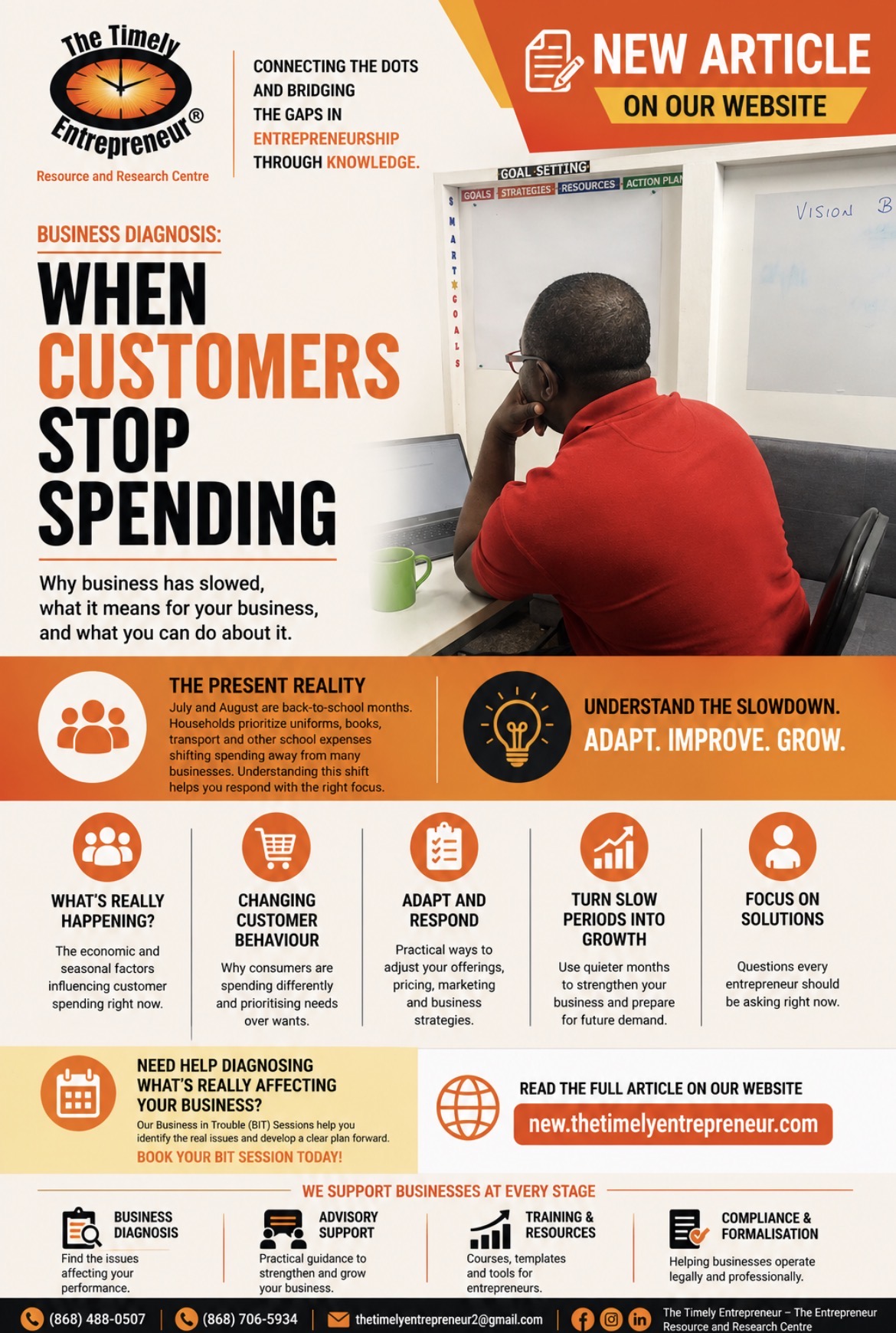
Business Diagnosis: A recurring editorial series from The Timely Entrepreneur Resource and Research Centre examining the issues affecting entrepreneurs and MSMEs in Trinidad and Tobago, together with practical ways businesses can respond.

When Customers Stop Spending: Understanding Today’s Business Slowdown

Helping entrepreneurs understand what’s really happening inside the economy and inside their businesses.

Over the past few weeks, we’ve had conversations with entrepreneurs from different industries, and we’ve been following the business news closely. One comment keeps coming up: – “Business has slowed.” Retailers are saying fewer customers are walking through their doors; service providers are receiving enquiries, but fewer people are committing. Some businesses are seeing customers delay purchases, while others are noticing that clients are buying less than they did just a few months ago. The question is, why?

The current business environment presents several challenges for entrepreneurs.

Business organisations have continued to express concerns about higher operating costs, foreign exchange constraints, increased business expenses and softer economic activity. These issues have placed pressure on many businesses across Trinidad and Tobago. At the same time, we are entering one of the most predictable spending periods of the year.

For many households, July and August are no longer ordinary months. They are back-to-school months. Parents are purchasing uniforms, textbooks, school shoes, stationery, transportation, electronic devices and paying registration fees for the new school term beginning in September.

When household budgets are stretched, spending priorities naturally change. This does not necessarily mean consumers have stopped spending; it often means they are spending differently. They have simply changed what they are spending on. Understanding that distinction is important. Economists often describe this as a shift from discretionary spending to essential spending. 

For businesses, this can feel like a sudden slowdown. But in reality, customer priorities have simply shifted. Recognising this shift is important because it helps business owners respond strategically rather than emotionally. For many households, these expenses become the priority.

Money that might previously have been spent on dining out, beauty services, entertainment, clothing or discretionary purchases is now redirected (for the next two months at least) towards education.

Consumer Behaviour Has Changed

Instead of asking,“Do I want this?”, they begin asking, “Do I need this right now?”, “Can this wait another month?”, “Is there a less expensive alternative?”, “Will this purchase solve an immediate problem?”

They are signs that customers are thinking differently and businesses that recognise this shift early are usually better positioned to respond.

Business Diagnosis

A temporary slowdown in sales is not necessarily a sign that your business is failing. It may be telling you something else. Perhaps your customers now need more flexible payment options. Perhaps your products or services need to be presented differently. Perhaps this is the right time to strengthen relationships with existing customers rather than focusing only on attracting new ones. Perhaps your pricing, marketing or customer experience needs to be reviewed. Every slowdown provides information. The challenge is learning how to interpret it.

Responding to Changing Consumer Priorities

Economic slowdowns rarely affect every business in exactly the same way. Some businesses continue growing. Others experience significant declines. The difference often lies in how quickly they recognise changing customer behaviour. Businesses should ask themselves an important question:

Has the way my customers buy changed?

If the answer is yes, the business may need to adapt. This does not interpret into lowering prices, as many businesses rush to do when sales aren’t moving. In fact, constant discounting can often make profitability even worse. Instead, entrepreneurs should consider whether their products or services can be presented differently. Could smaller service packages make purchasing easier? Would payment plans encourage customers to proceed? Could products be bundled to increase value? Would subscription or membership options improve recurring income? Can premium services be complemented by more affordable entry-level options?

The objective is not simply to sell more. It is to remain relevant to changing customer needs.

Sometimes the Business Model Needs to Change

One of the greatest dangers during slower periods is assuming that doing more of the same will produce different results. Markets evolve, and so too, do customer expectations, and hence, businesses must evolve too.

A tutor who previously offered only private lessons may introduce small group classes. A restaurant may create family meal packages or corporate lunch specials. A consultant may offer shorter advisory sessions for clients unable to commit to larger projects. A retailer may strengthen online sales and delivery services. A beauty salon may introduce express treatments for customers seeking more affordable options. A contractor may expand into maintenance contracts that generate recurring income rather than depending entirely on new construction projects.

One area of business we see struggling consistently is Consultancy. Consultancies are among the first businesses to feel an economic slowdown because many clients view consulting as something they can postpone. However, the businesses that survive don’t stop selling expertise. They repackage it to match what clients can afford and need at that moment.

Perhaps think in terms of a value ladder, where clients can enter at different price points instead of assuming everyone is ready for a full consulting engagement. Rather than assuming every client is ready for a comprehensive consultancy engagement, consider developing a range of services at different investment levels. A business that cannot commit to a full consulting package today may still invest in a one-hour Business Health Check, a Pricing Review, a Compliance Assessment or a Business Recovery Session. Smaller engagements often build trust, solve immediate problems and naturally lead to larger consulting opportunities when the client’s circumstances improve. These adjustments do not change the identity of the business. They simply reflect a willingness to respond to current market conditions. History consistently shows that businesses prepared to adapt are often the ones that emerge strongest after periods of economic uncertainty.

Slow Periods Can Become Growth Periods

Many entrepreneurs view slower periods as lost time. In reality, they can become some of the most valuable months in the business calendar. When customer demand slows, owners finally have time to work on the business instead of constantly working in it.

This is an ideal opportunity to:

  • Review pricing.
  • Analyse profitability.
  • Identify hidden profit leaks.
  • Improve record keeping.
  • Strengthen customer relationships.
  • Reconnect with past clients.
  • Update marketing materials.
  • Improve social media presence.
  • Review supplier costs.
  • Improve inventory management.
  • Formalise business processes.

Businesses that invest in improvement during quieter periods often recover faster when demand increases.

Questions Worth Asking

If business has slowed, ask yourself:

  • Have my customers’ spending priorities changed?
  • Am I communicating the value of my products or services clearly?
  • Have I stayed in contact with existing customers?
  • Have I reviewed my expenses over the past three months?
  • Are there complementary products or services I could introduce?
  • Is my cash flow strong enough to manage seasonal fluctuations?
  • Am I relying too heavily on one source of income?
  • Could my business benefit from introducing something new?

These questions won’t solve every challenge, but they often reveal opportunities that are easy to overlook when you’re busy running the business.

The Timely Takeaway

Economic slowdowns test every business. Some businesses respond by waiting. Others respond by adapting. Entrepreneurs cannot control inflation. They cannot control consumer confidence. They cannot control foreign exchange availability. They cannot control household spending.

They can, however, control how prepared their businesses are to respond. The businesses most likely to succeed are not always the largest. They are often the ones that understand their customers, know their numbers, manage their costs and remain willing to adapt when circumstances change.

Sometimes the greatest opportunity for growth begins during a period that initially feels like decline.

How We Help

At The Timely Entrepreneur Resource and Research Centre, our Business in Trouble (BIT) Sessions help entrepreneurs look beyond the symptoms.

A slowdown in sales is often only one part of the story. Together, we examine pricing, cash flow, expenses, profitability, customer trends, business systems and operational practices to identify what is really affecting performance. Sometimes the issue is the economy; other times it is the business. More often, it is a combination of both.

Helping businesses start, survive and grow.

🌐 new.thetimelyentrepreneur.com

πŸ“ž (868) 488-0507 | (868) 706-5934

Timely Business Action Plan

This Week’s Actions

☐ Review your July and August sales against last year.

☐ Contact five existing customers.

☐ Review your three highest-cost expenses.

☐ Identify one service you could repackage.

☐ Schedule one hour to work on your business instead of in it.

☐ Review your pricing.