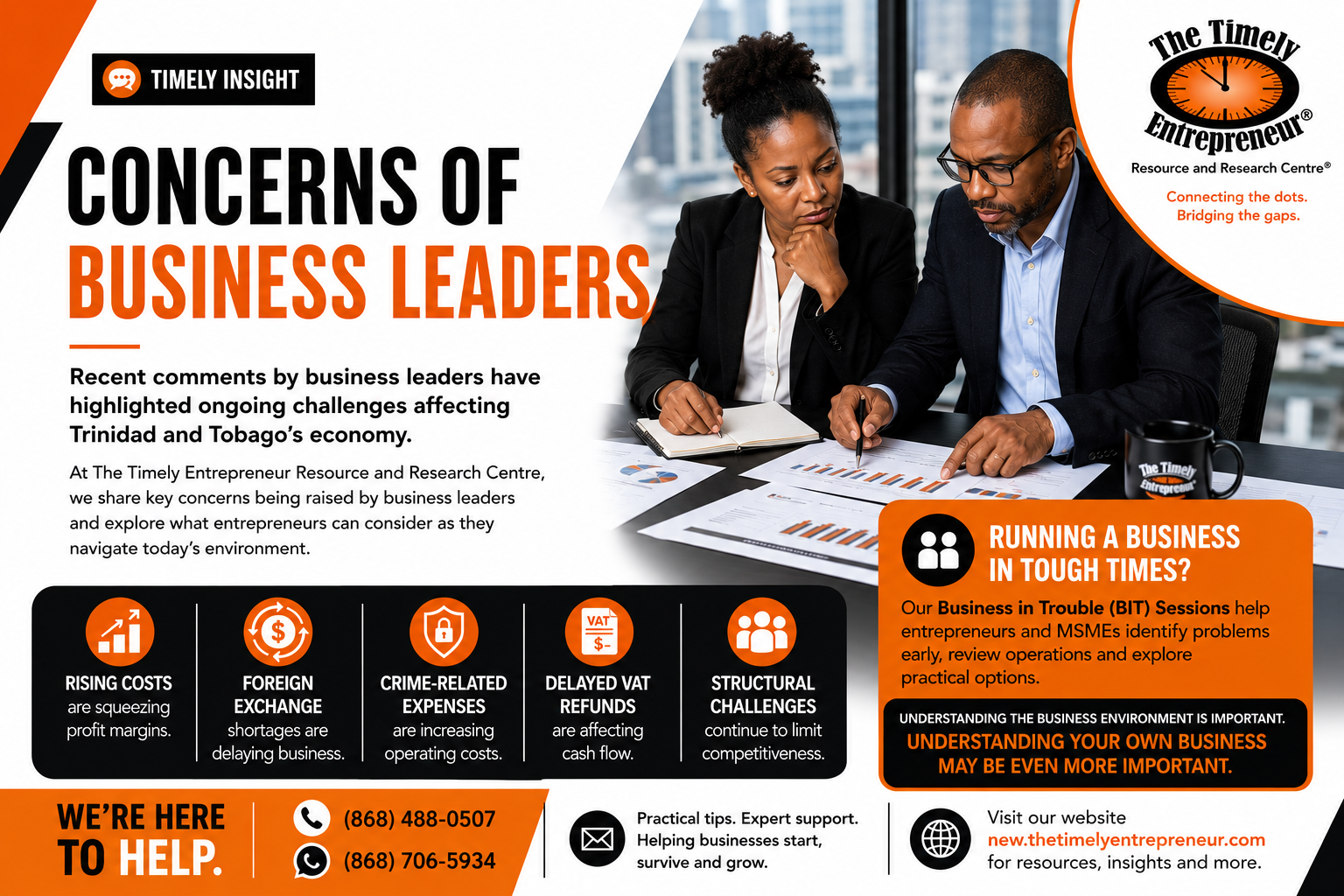
Recent comments by businessman Robin Ojeer and Sieunarine Kumar Hardath, director of Hardath General Insurance Consultants Ltd, have reignited discussion about the state of Trinidad and Tobago’s economy. Both businessmen point to issues that many entrepreneurs and business owners have been quietly confronting for years: rising operating costs, foreign exchange constraints, delayed VAT refunds, crime-related expenses and what they perceive as a lack of meaningful progress on deeper structural challenges affecting the economy.
Read the full article via Guardian Media here: https://www.guardian.co.tt/business/tts-economy-is-dying-businesses-lash-govt-policies-6.2.2608899.34357468a3#google_vignette
At The Timely Entrepreneur Resource and Research Centre, we believe these concerns deserve careful consideration, not because they represent isolated opinions, but because they reflect realities being experienced across the business landscape. Whether one agrees with every criticism or not, the observations made by Ojeer and Hardath raise important questions about confidence, competitiveness and the operating environment facing micro, small and medium-sized enterprises. More importantly, they remind us that understanding the broader economy is essential for entrepreneurs seeking to make sound decisions in increasingly uncertain times.
These rising operating costs, crime-related expenses, limited access to foreign exchange and increasing uncertainty are creating conditions that are becoming difficult for many firms to navigate. Recent reactions to the Mid-Year Budget Review have highlighted concerns that the challenges facing businesses are not being adequately addressed.
For many entrepreneurs, these concerns are not theoretical. They are being experienced every day.
Security costs continue to rise. Businesses are spending more on cameras, alarms, gates, insurance and private security, adding another layer of expense to already strained operations. Small businesses, which often operate on tight margins, are finding it increasingly difficult to absorb these additional costs.
The foreign exchange shortage remains another major source of concern. Importers and manufacturers are experiencing delays and uncertainty when trying to access US currency to purchase goods and raw materials. Businesses that depend on imported products are often forced to source foreign currency elsewhere at higher costs, which eventually affects pricing and profitability.
Economic uncertainty itself creates another problem. When consumers become cautious about spending, businesses experience slower sales and reduced cash flow. Expansion plans are delayed, investments are postponed and confidence weakens.
While many business owners are looking to government policies for relief, entrepreneurs must also recognise that survival cannot depend entirely on external solutions. Businesses that are waiting for perfect economic conditions may find themselves waiting indefinitely.
This period calls for stronger internal management and greater adaptability.
Business owners should pay close attention to cash flow and reduce unnecessary expenses. Inventory management, debt collection and pricing decisions require constant review. Businesses that understand their numbers are generally better positioned to respond to changing conditions.
Diversification is becoming increasingly important. Companies that rely heavily on a single customer, product or revenue stream face greater vulnerability. Exploring new markets, introducing complementary services and embracing digital opportunities can help reduce risk.
Local sourcing should also be considered where possible. Although not every imported item can be replaced, businesses that develop relationships with local suppliers may reduce some of their exposure to foreign exchange challenges.
Another area requiring attention is business formalisation and compliance. In difficult economic times, access to financing, partnerships and growth opportunities often favours businesses that maintain proper records and operate within regulatory requirements. Informal businesses may find themselves excluded from opportunities precisely when they need them most.
This reality is particularly relevant in our business eco-system, where many micro and small enterprises operate successfully for years without formal registration, proper records or full compliance. Home-based caterers, online retailers, hairdressers, barbers, tutors, contractors, event planners and service providers often generate steady income and maintain loyal customers, yet remain vulnerable when circumstances change. During difficult economic periods, these businesses may discover that the absence of proper systems and documentation limits their ability to access loans, secure insurance, participate in government procurement, attract investors or form partnerships with larger organisations.
Ironically, the very moment when a business needs support, whether because of rising costs, declining sales or the need to expand into new markets, is often when informality becomes a disadvantage. A contractor with years of experience but no documented financial records may struggle to obtain financing. A home-based food business may be unable to supply larger institutions. An online retailer with strong sales may find itself excluded from opportunities requiring proof of income, business registration or compliance. In an increasingly demanding environment, formalisation is no longer simply about satisfying regulatory requirements. It is about positioning businesses to access opportunities, withstand shocks and remain competitive.
Perhaps the greatest danger facing businesses today is not simply the economic environment, but the temptation to become paralysed by uncertainty, as we have been seeing here at The Timely Entrepreneur. Difficult periods demand careful decisions, but they also require action.
Trinidad and Tobago has faced economic challenges before. Businesses have survived recessions, pandemics, foreign exchange shortages and changing markets. Those that endured were not necessarily the largest or the strongest. They were often the ones willing to adjust, rethink and remain disciplined.
The concerns being raised by businesses deserve serious attention. Because while entrepreneurs cannot determine national economic policy, they can determine how prepared their businesses are to navigate an increasingly demanding environment. However, entrepreneurs cannot afford to surrender their future to circumstances beyond their control. Economic conditions may be challenging, but good management, sound decision-making and adaptability remain powerful tools for survival.
At The Timely Entrepreneur Resource and Research Centre, we continue to believe that knowledge, preparation and practical support remain essential for businesses seeking not only to survive difficult times, but to position themselves for long-term growth.
While uncertainty may be unavoidable, helplessness is not!
Is Your Business Feeling the Pressure?
If rising costs, declining sales, cash flow challenges or uncertainty about the next step are beginning to affect your business, it may be time for an objective review.
Through our Business in Trouble (BIT) Sessions, The Timely Entrepreneur Resource and Research Centre works with entrepreneurs and MSMEs to identify problems early, review operations and explore practical options before small issues become major crises.
Understanding the business environment is important. Understanding your own business may be even more important.