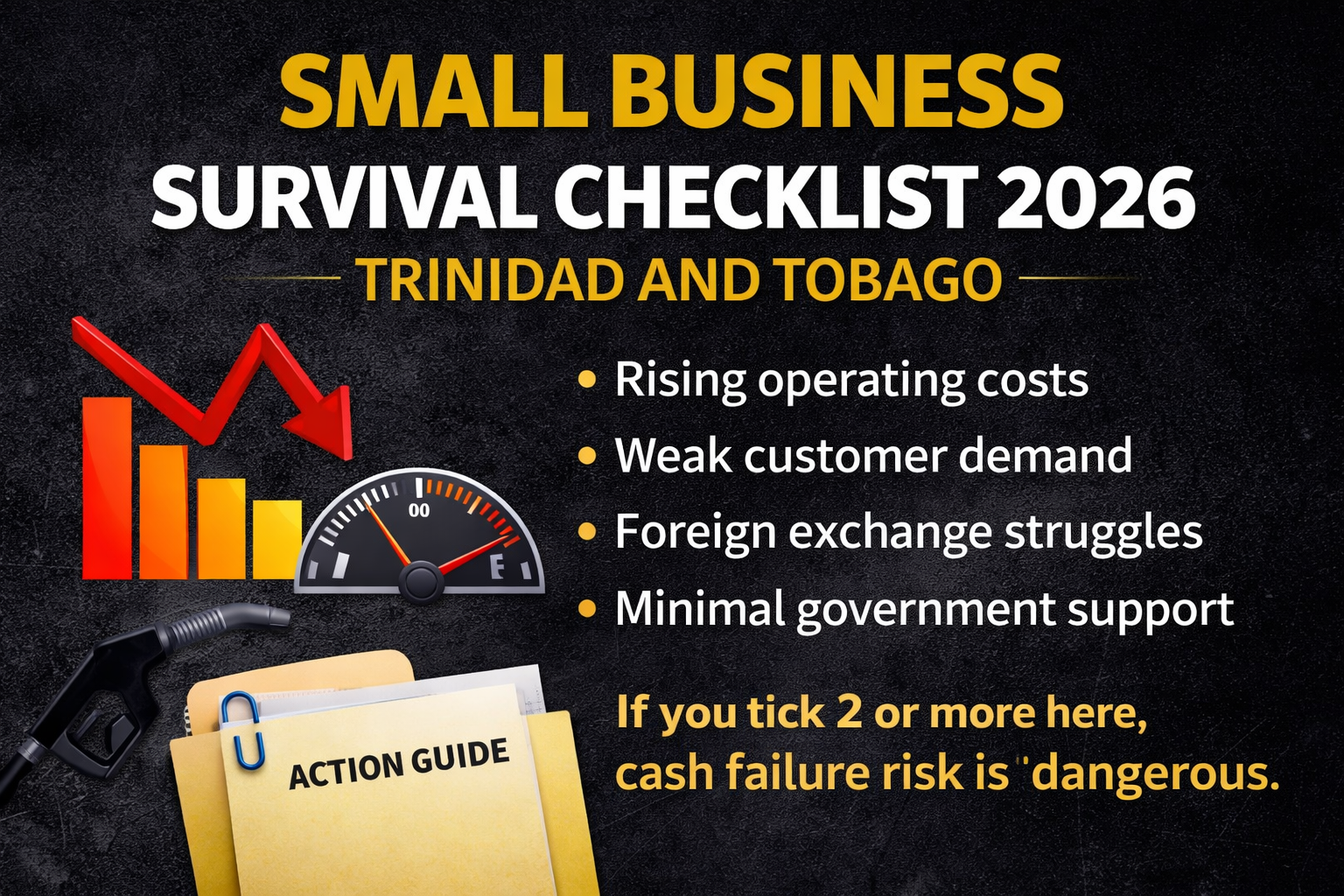
The 2026 economic reality
The team at The Timely Entrepreneur Resource and Research Centre met recently to discuss the Economic Outlook for 2026. Here is a direct, unsentimental assessment for 2026, written for people who actually have to survive in the Trinidad and Tobago economy.
Stripped of comfort language
The outlook for 2026 is fragile and deteriorating beneath the surface. The headline numbers still lean on energy, but the underlying economy is showing classic late-cycle stress. Growth is narrow, costs are sticky, foreign exchange remains structurally constrained, and the State’s room to cushion shocks is shrinking.
Energy revenues may hold up on paper, but gas supply constraints, maintenance downtime, and global price volatility mean cash flows will be uneven. Non-energy growth is weak because domestic demand is under pressure and operating costs are rising faster than incomes. See more below:-
Why non-energy growth in Trinidad and Tobago is weak
1. Real household income is falling
Wages in the non-energy economy have not kept pace with cumulative increases in food, utilities, rent, transport, insurance, and education costs. When real income declines, discretionary spending contracts. Non-energy sectors depend heavily on domestic consumption, so lower purchasing power translates directly into weaker sales volumes.
2. Domestic demand is narrow and concentrated
Consumption is concentrated in essentials. Spending on non-essential goods and services is being postponed or reduced. This limits growth in retail, hospitality, personal services, creative industries, and discretionary manufacturing.
3. High operating costs compress margins
Non-energy businesses face rising electricity charges, logistics costs, rent, security, insurance, and compliance expenses. These costs increase faster than revenues, forcing firms to scale back operations, delay expansion, or exit markets.
4. Foreign exchange constraints restrict supply
Non-energy sectors are import-dependent for inputs, equipment, raw materials, and inventory. FX shortages delay restocking, raise supplier prices, and reduce production capacity. Firms cannot scale output without reliable access to foreign exchange.
5. Limited access to affordable credit
Tighter bank lending standards, higher interest rates, and stricter documentation requirements reduce financing for expansion, working capital, and technology upgrades in non-energy sectors.
6. Weak productivity growth
Capital investment outside energy is limited. Many firms operate with outdated equipment, inefficient processes, and limited automation. Productivity gains are insufficient to offset rising costs, keeping unit costs high.
7. Public sector consolidation dampens spillovers
Fiscal restraint limits public-sector driven demand and procurement spillovers that historically supported non-energy activity. Delays in State payments further constrain cash flow for contractors and suppliers.
8. Small market size limits scale
Trinidad and Tobago’s domestic market is limited. Without consistent export expansion, non-energy firms face saturation quickly, capping growth potential.
9. Business confidence is fragile
Uncertainty around taxes, compliance enforcement, energy prices, and economic policy timing reduces private investment. Firms postpone hiring, capital spending, and market expansion.
10. Structural dependence on energy revenues
Non-energy activity remains indirectly tied to energy through public spending, FX availability, and liquidity. When energy performance softens or becomes volatile, non-energy sectors slow even if their fundamentals are unchanged.
These factors operate simultaneously. The result is low volume growth, thin margins, and limited expansion capacity across the non-energy economy.
Inflation is no longer the sudden spike of previous years. It is now embedded. Food, utilities, insurance, logistics, rent, compliance costs, and financing charges are resetting at higher levels and staying there. That is more dangerous for small businesses than short bursts of inflation, because it erodes margins quietly and continuously.
The foreign exchange situation remains a structural problem. It is not a temporary shortage. Import-dependent businesses will face delays, higher supplier demands for prepayment, and periodic inability to restock. This will worsen as global credit tightens and correspondent banking becomes more conservative.
Government Policy Impacts
Government policy in 2026 signals restraint, not rescue. Here is what this really means in concrete, observable terms.
1. No broad stimulus spending
The 2026 fiscal stance is not expansionary. There is no large-scale injection of new spending designed to boost demand across the economy. Capital expenditure is selective and controlled, not wide-ranging. This means the State is not stepping in to lift consumption or offset private-sector weakness.
2. Tight control over recurrent expenditure
Government is focused on containing wage growth, transfers, and subsidies. Any increases are targeted and limited. This signals that protecting fiscal balances is a higher priority than cushioning households or businesses broadly.
3. Rationalisation of subsidies and concessions
Energy, utility, and social subsidies are being reviewed and narrowed. The direction is toward reducing fiscal leakage, not expanding relief. Businesses should expect less price buffering from the State and more exposure to real market costs.
4. Emphasis on compliance and revenue collection
Policy focus has shifted from accommodation to enforcement. Tax compliance, NIS contributions, fees, and penalties are being tightened. This raises revenue without stimulating activity and increases operating pressure on firms that are marginal or informal.
5. Cost-shifting rather than cost-absorption
Instead of absorbing rising costs, government policy increasingly passes them through to users and businesses. Examples include higher fees, utility adjustments, and reduced concessions. This is a restraint signal because it prioritises fiscal sustainability over short-term relief.
6. Limited intervention in distressed sectors
There is no clear framework for widespread bailouts, debt relief, or emergency support for struggling industries or MSMEs. Assistance is conditional, case-by-case, or indirect. Firms cannot assume the State will step in if conditions worsen.
7. Conservative fiscal assumptions
Budget projections rely on cautious spending paths rather than optimistic growth-driven revenue expansion. This reflects risk aversion and a desire to preserve buffers, not deploy them aggressively.
8. Protection of fiscal buffers over economic stimulus
Foreign reserves, the Heritage and Stabilisation Fund, and debt metrics are being preserved. The State is signalling that these buffers are for systemic crises, not for sustaining weak growth or propping up businesses.
What this means in plain terms
The Government’s posture in 2026 is one of containment and discipline, not economic rescue. It is managing downside risk to public finances rather than attempting to reignite growth through spending or relief.
For businesses and households, this means:
- Do not expect sweeping relief measures.
- Do not rely on subsidies to stabilise costs.
- Do not assume government intervention if cash flow tightens.
The burden of adjustment is being shifted to the private sector and households.
Subsidies are being rationalised, compliance is tightening, and social spending is being re-targeted. Small businesses should assume less tolerance for arrears, less flexibility from State agencies, and more scrutiny, not more support. Click the link to read more on this here: Build Wealth, Don’t Depend on NIS
Hard truths small businesses must accept now
First, revenue instability is the new normal. If your business requires steady monthly sales just to survive, it is already at risk.
Second, cost increases will not reverse. Electricity, rent, shipping, and insurance costs in Trinidad and Tobago are structurally higher, not temporarily elevated. They are driven by fuel pricing, utility cost recovery, insurance risk re-pricing, global logistics costs, crime exposure, and tighter regulatory requirements. None of these drivers are reversing in the near term.
Businesses that delay price adjustments, cost restructuring, or operating changes in the hope that these expenses will fall are basing decisions on expectation rather than evidence. Since revenues are not rising at the same pace, waiting erodes margins, drains cash, and weakens the business each month.
In practical terms, hoping costs will fall postpones necessary action and increases the risk of failure.
Third, access to finance will tighten further. Banks will lend, but only to businesses that can show discipline, documentation, and predictable cash flows. Informality will be punished quietly simply through denial. In 2026, informal businesses are unlikely to be shut down publicly or aggressively. Instead, they will be excluded. They will be denied access to bank financing, government contracts, corporate clients, digital payment platforms, insurance coverage, and formal partnerships because they cannot meet documentation, compliance, or reporting requirements. No warning is required for this to happen.
The punishment is quiet because the business is not confronted or prosecuted. It simply finds that doors stop opening, opportunities disappear, and growth becomes impossible.
Fourth, customer behaviour has changed permanently. Households are trading down, delaying purchases, sharing services, and questioning value more aggressively. Loyalty is thinner. Price sensitivity is higher. Households and businesses have less discretionary income and tighter cash flow. Customers compare prices more closely, trade down to cheaper alternatives, reduce quantities, or stop buying altogether when prices rise. This means small price increases now trigger stronger reactions than in the past, directly affecting sales volume and customer retention.
Fifth, compliance is no longer optional camouflage. Businesses that “fly under the radar” will struggle to scale, access credit, or partner with corporates and institutions.
What small businesses must do immediately to survive 2026
1. Ruthless financial control
You must know, weekly, not monthly:
- Which products or services actually generate cash.
- Which ones only generate activity.
- Your true break-even point with current costs, not last year’s.
Cut offerings that drain cash, even if they are popular or emotionally attached. Popular does not pay bills.
Move from annual thinking to rolling 90-day cash forecasting. If you cannot see three months ahead, you are already late.
2. Rebuild pricing around reality, not fear
Many small businesses are underpricing out of fear of losing customers. In 2026, underpricing is more dangerous than losing low-value customers.
You must:
- Separate price-sensitive customers from value-driven ones.
- Create tiered offerings, not one price for everyone.
- Be explicit about what costs more and why.
If customers cannot accept price increases, then reduce scope, not margins.
3. Reduce dependency risks
If your business relies on:
- One supplier.
- One major customer.
- One income stream.
- One location.
- One platform.
You are exposed.
Diversify suppliers locally where possible, even at slightly higher unit cost. Reliability beats cheap in unstable conditions.
Build at least one secondary income line that is not dependent on imports or long credit chains.
4. Formalise selectively but properly
You do not need excessive bureaucracy, but you do need:
- Clean records.
- Up-to-date filings.
- Basic management accounts.
This is not about pleasing the State. It is about surviving when cash tightens and only disciplined businesses can negotiate, borrow, or pivot.
5. Shift from growth obsession to resilience
2026 is not about rapid expansion. It is about endurance.
That means:
- Smaller, stronger operations.
- Fewer fixed costs.
- More variable cost models.
- Leasing instead of buying where possible.
- Partnerships instead of solo scaling.
Practical income generation and diversification paths that make sense now
Not all diversification is smart. Many small businesses fail because they chase everything. The following directions reflect actual economic pressure points:
1. Service over product where possible
Services:
- Require less foreign exchange.
- Adjust prices faster.
- Carry lower inventory risk.
Knowledge-based services, maintenance, training, compliance support, repair, and local logistics will outperform imported retail over the next two years.
2. Recurring income models
One-off sales are unstable in a tightening economy.
Think in terms of:
- Retainers.
- Subscriptions.
- Maintenance contracts.
- Memberships.
- Bundled service periods.
Predictability is power in uncertain conditions.
3. B2B over B2C where feasible
Households are under pressure. Businesses still need services to operate.
Target:
- SMEs that must remain compliant.
- Corporates outsourcing non-core functions.
- Schools, NGOs, and institutions with budgeted spending cycles.
Margins may be tighter, but payments are more predictable.
4. Local substitution niches
Import friction creates opportunity.
Look for:
- Products or services businesses importing simply because “that’s how it’s always been.” Many businesses continue importing certain products or services out of habit rather than necessity. The original reasons may have been quality, availability, or cost advantages that no longer exist. In the current environment, import dependence driven by routine rather than analysis increases exposure to foreign exchange shortages, shipping delays, and higher costs, even when local or regional alternatives could meet the need adequately.
- Small-batch local alternatives – this refers to locally produced goods or services made in limited quantities that substitute for imported products. They reduce foreign exchange exposure, shorten supply chains, and allow faster price and product adjustments. They may not match large-scale imports on volume or unit cost, but they offer reliability, flexibility, and resilience in a constrained economic environment.
- Hybrid models where part of the value is local. Hybrid models are business arrangements where some components are imported, but a significant portion of the value creation happens locally. This can include local assembly, customization, servicing, packaging, or distribution. These models reduce foreign exchange exposure, lower logistics risk, and allow businesses to maintain functionality and quality while adapting to supply constraints and cost pressures.
You do not need to replace imports entirely. You only need to reduce dependency.
5. Regional and digital income streams
TT is a small market with limited growth.
Digital services, remote consulting, content-based products, online training, and regional service delivery reduce dependence on local demand alone. Foreign currency income is a buffer, not a luxury.
The uncomfortable conclusion
2026 will not reward hope, optimism, or hustle alone. It will reward discipline, realism, and adaptability.
Small businesses that survive will not be the loudest or most visible. They will be the ones that:
- Control cash tightly.
- Price honestly.
- Cut early rather than late.
- Diversify carefully, not emotionally.
- Accept that the environment has changed and act accordingly.
This is not an economic collapse where all businesses fail at once. Economic activity continues, but under tighter conditions. It is a sorting phase where businesses with weak finances, poor pricing, high dependency, or low discipline are pushed out, while those that are well-managed, adaptable, and resilient remain and gain market share.
Businesses that adjust now will still be standing when conditions improve. Those that wait for things to “go back to normal” will quietly exit.